Transcripts & Collations
Wanley's Transcriptions
Humphrey Wanley discovered Beowulf in the library of Sir John Cotton in the late 17th century before the manuscript was extensively damaged by fire in 1731. In his famous Catalogus historico-criticus (1705), his substantial transcriptions (pp. 218–219) from fol. 129r1–18 and fol. 130r8-20 through fol. 130v1-4 alone preserve six lost letters, confirm the now partly covered and faded word, yldo, and are the only original source of the word medo on fol. 130v1.
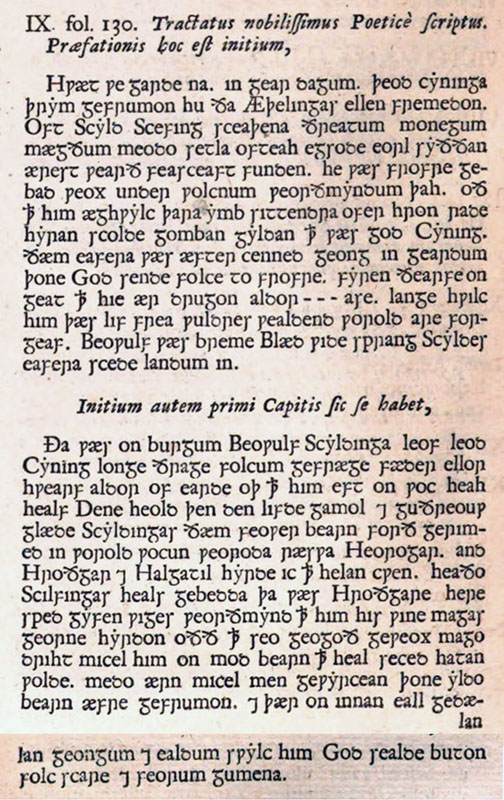
Wanley's description of the poem bypasses the folktale aspects of monsters and dragons, which modern scholars have emphasized since Tolkien's "The Monsters and the Critics." Wanley was interested instead in what he considered the historical elements. By centering on the wars Beowulf fought against Swedish petty kings, moreover, Wanley showed that he had read the entire poem.
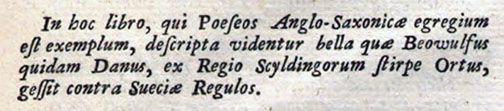
Based on his transcriptions, Wanley did not confuse the young Beowulf, hero of the poem, with Scyld's son Beowulf, who fathered Healfdene, the father of Heorogar, Hrothgar, Halga, and a daughter who married a Swedish Scilfing. For Wanley, the hero Beowulf was a later descendant, "from the family of the royal house of the Scyldings," as he translated "ex Regio Scyldingorum stirpe Ortus" in a 1704 letter to the Swedish scholar Eric Benzelius.
The Thorkelin Transcripts
The transcript known as Thorkelin A was in all likelihood made by James Matthews, a British Museum staff member that Grímur Jónsson Thorkelin apparently hired in 1787 while he was in Scotland. Thorkelin himself made a second copy, known as Thorkelin B, ca. 1789–90, sometimes relying on A and sometimes making changes later in Denmark. He and Matthews together saved about 2000 letters that were subsequently lost by fire damage as a consequence of the Cottonian Library fire in 1731. While it is critical to keep the sigla A and B for purposes of reference, it is equally important to recognize the major contribution James Matthews made to the preservation of the text of Beowulf.
Matthews A and Thorkelin B
For an extensive introduction (Thorkelin's Discovery of Beowulf), a comprehensive collation, and a critical analysis (The Reliability of the Transcripts and Conclusion) of these indispensable copies of Beowulf before fire-damage severely harmed the manuscript, see Kiernan, The Thorkelin Transcripts of Beowulf (Copenhagen 1986). The restored Thorkelin readings are all incorporated in the text and presented in the texutal notes; users may examine details by double-clicking any reading in (round) or [square] brackets
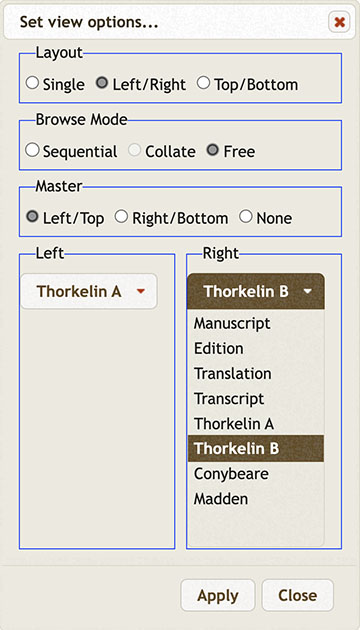
To set viewing options for both transcripts, go to Views in the top menu, select Change View, and in the window that opens choose a 'Layout' with 'Browse Mode' set to 'Free.' This setup lets the user compare the two Thorkelin transcripts section by section.
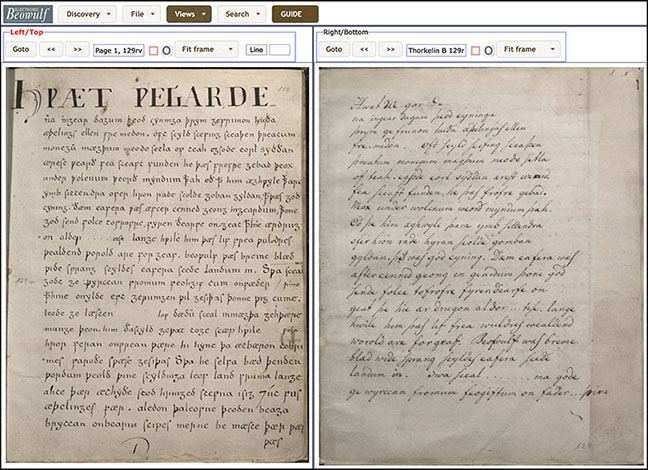
James Matthews / Thorkelin A
James Matthews (A) used large, British Museum issue paper and copied continuously, rather than copying the Beowulf MS page by page and line by line, as Thorkelin did. Top/Bottom layout permits wide views of Matthews/Thorkelin A with the MS on smaller screens.
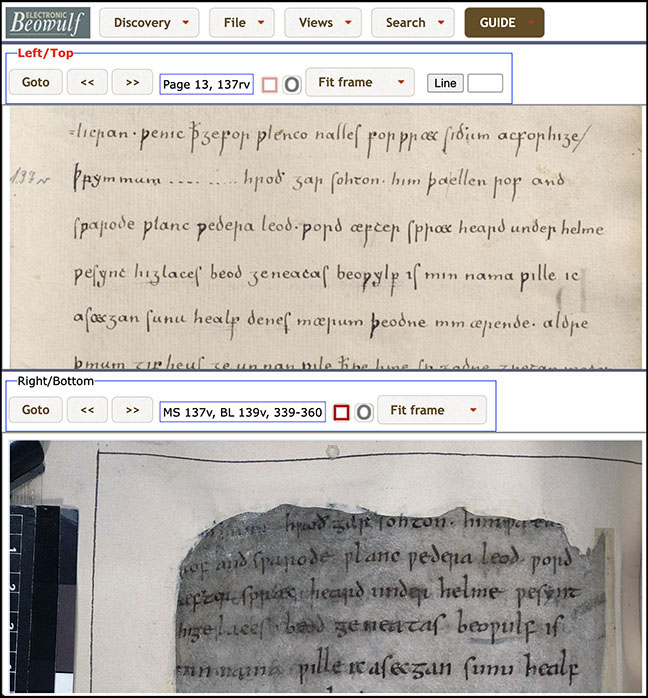
Manuscript foliation
The "Manuscript foliation" was written after the fire on the upper-right recto leaves of the manuscript itself. Conybeare, Madden, Zupitza and most modern editors, including Klaeber 3 and 4, all used the MS foliation. Two folios now numbered 147A(131) and 189A(197) were misplaced sometime after Matthews and Thorkelin made their transcripts, and after Thorkelin left England in 1791, as the correct order in these documents proves. Today their dual numbers show their correct locations (147A before 147, 189A before 189) and their former misplacement (131 and 197).
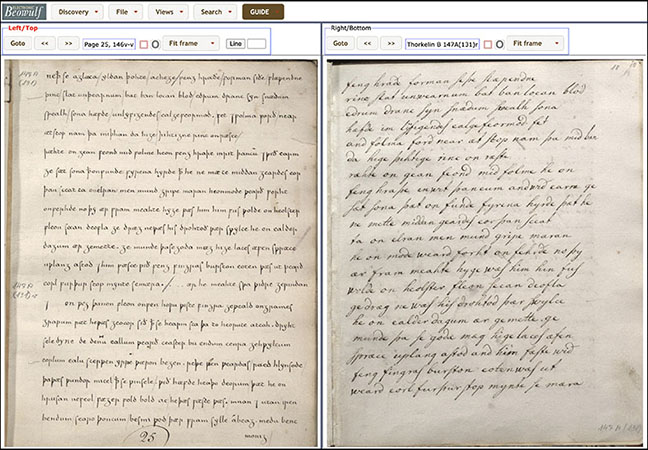
Because Matthews copied continuously, 147A(131) appears twice in the left margin where the recto and verso begin; because Thorkelin copied page by page, only one folio number appears in the lower right corner in his transcript.
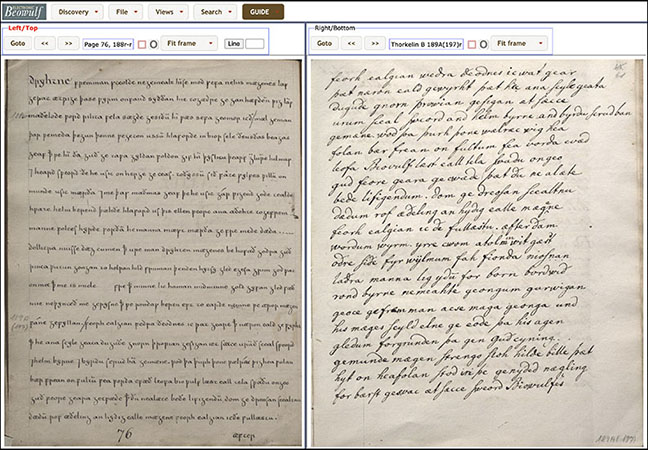
In Matthews, 189A(197) recto appears in the left margin after 188v, while in Thorkelin only 189A(197) appears in the lower right corner.
The misplacement of these two leaves happened for different reasons. For 197 see The misplaced folio 189A(197). For 131 the most likely suspect is Sharon Turner, who used the manuscript after Thorkelin left England for Denmark in 1791. It is also possible that a member of the Museum staff had misplaced the folio and then wrote the manuscript foliation. In his "History of the Poetry of the Anglo-Saxons" (1805), Turner in any case had the leaf misplaced when he haplessly translated the result:
The song of the poet said,
He who knew
The beginning of mankind
From afar to narrate. (130v)
"He took wilfully (147A[131]r)
By the nearest side
The sleeping warrior.
He slew the unheeding one
With a club on the bones of his hair" (p. 402).
Using the manuscript foliation
By not following the exact format of the manuscript, Matthews' method of copying continuously makes it difficult to collate with either the manuscript or with Thorkelin B. In 1983, to facilitate collations by scholars, the Keeper of Manuscripts at the Royal Library authorized the addition in pencil of Beowulf manuscript folio numbers in the margin of Matthews / Thorkelin A; a diagonal stroke in a line shows where the new manuscript leaf begins.
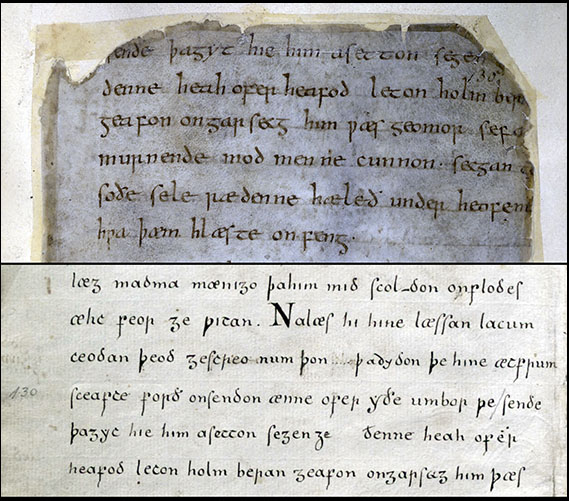
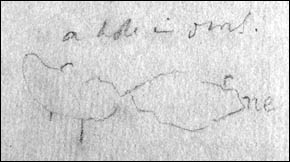
In this example, folio number 130 is in the upper-right corner of the manuscript, and in the left margin of Matthew's transcript, with a slash-mark before sende to show where the new page begins.
Proofreading in Matthews A
After he had learned to distinguish thorn and wynn from p, James Matthews began proofreading his work, correcting p to thorn or wynn where needed, and making some interlinear corrections with a smaller, more practiced imitation of insular script. He did not get very far in his proofreading. In 1787, the date of the A transcript, James Matthews died.
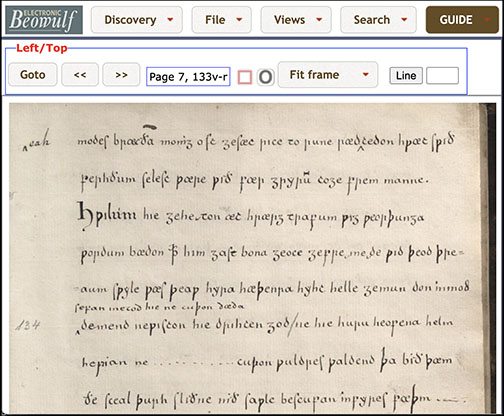
Matthews' skill in copying insular script improved radically in the course of his work, and it is usually easy to detect later additions and corrections by him. If they involve the restored text, these later changes are listed in the textual notes.
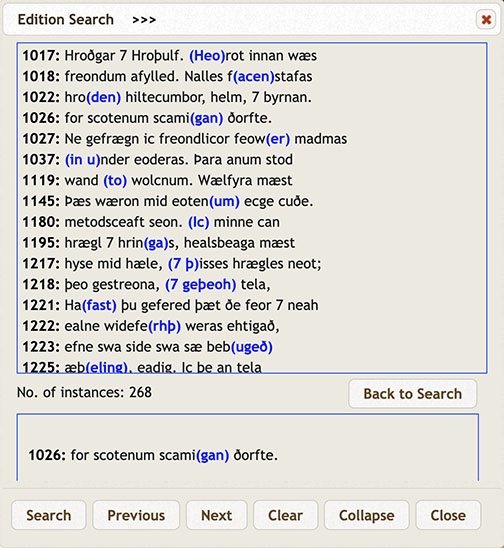
In the Apparatus an Edition Search under Early Restorations for Transcript A shows that Matthews was the primary source for saving 268 letters, parts of words, and words.
Thorkelin B
The reliability of Thorkelin's own transcript presents many difficulties for an editor, in part because Thorkelin had Matthews' Thorkelin A to consult as he made the second transcript, in part because he was devising a first edition and his Latin translation of the poem.
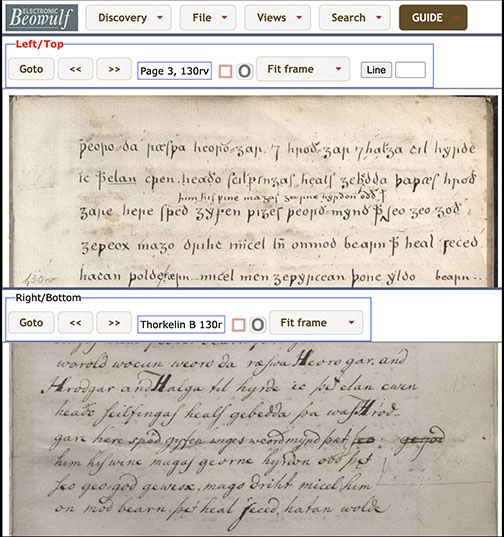
Thorkelin began but later erased an interlinear Latin translation in A (pp. 2-6). His occasional dependence on A in later proofreading, rather than on the manuscript, is here evident in his transcript of fol. 130r17, where he begins to omit the same line as A. Thorkelin was also incorporating Wanley's transcriptions, because on the next page, fol. 130v1, he writes medo where Matthews shows that the reading was gone.
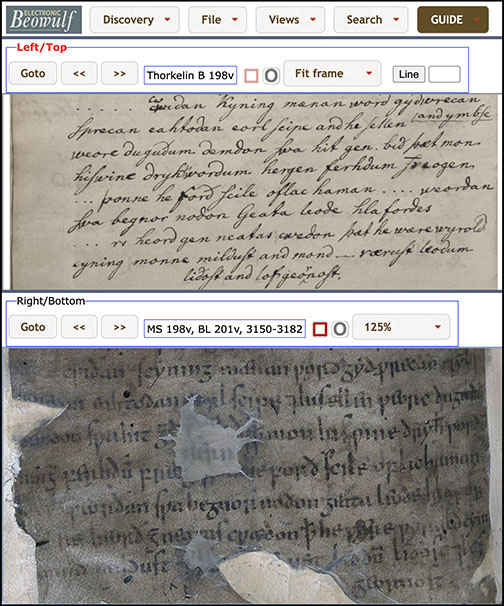
Thorkelin B is at its best when A does not provide readings, either on purpose or by accident. Although he oddly abandons following the manuscript line by line on the last page, B alone saw the ð in bið 198v17 (original d crossed later) and to a rare macron above g in freoge 198v18, which he erroneously expanded to freogen.
Nineteenth-Century Collations
John J. Conybeare and a young Frederic Madden in the early nineteenth century produced two collations of the Beowulf manuscript with Thorkelin's 1815 first edition of Beowulf. Together these collations help test the accuracy of the two transcripts and of Thorkelin's' edition, as well as the usefulness of their own collations.
Unlike Madden, Conybeare could read Old English. He had been Professor of Anglo-Saxon at Oxford 1808–1812 and Professor of Poetry when he made his collations. When he met Madden in 1824, Conybeare's Illustrations of Anglo-Saxon Poetry was in proof (since 1821) and his personal library contained virtually every Anglo-Saxon book in print. (For information cited in this section, see Kiernan, "The Conybeare-Madden Collation of Thorkelin's Beowulf.")
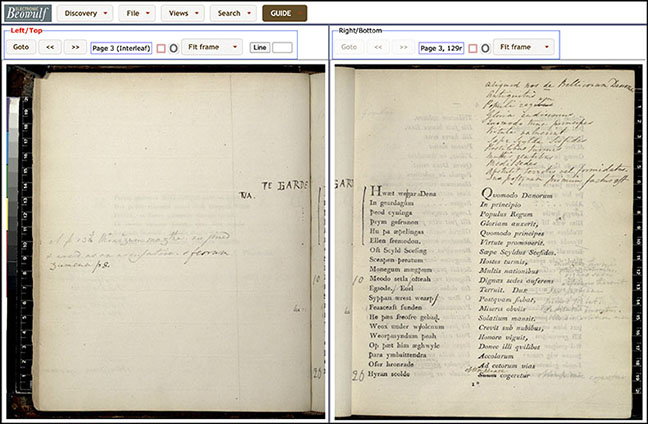
One of these books was an interleaved copy of Thorkelin's 1815 edition of Beowulf, which John Conybeare's brother William had given him for his birthday in 1815. Making the arduous journeys between Oxford and London, Conybeare wrote his first collation in brown ink, finishing it in summer 1817. Over the next two years, 1818–1819, he returned to make another collation, this time written in pencil.
Conybeare's collations
Conybeare was the first person to cite the manuscript foliation of Beowulf. Because he understood Old English, he recognized soon after he began collating that the folio numbered 131 following 130v was out of place. He confidently wrote on the interleaf facing it that the folio numbered 131 had been inserted from another place.
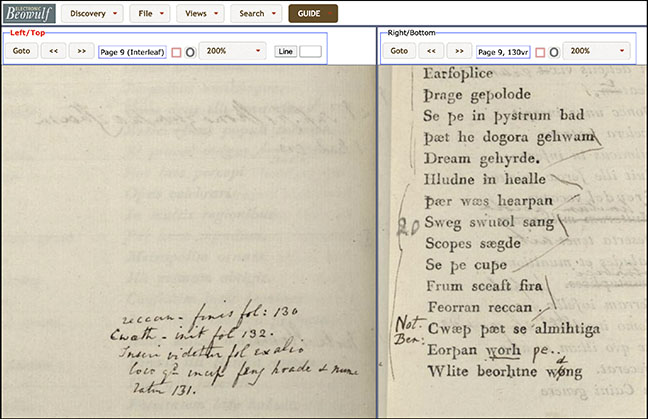
This conclusion was vindicated later in his collation, when Conybeare located where the misplaced folio 147A(131) belonged. He recognized that it was correctly printed on pages 58–61 of Thorkelin's edition, between folios 146 and 147 of the manuscript. Conybeare meticulously marked the start of 147A(131)r (-feng) on page 58 and the end of 147A(131)v (Sweg) on the interleaf of page 61.
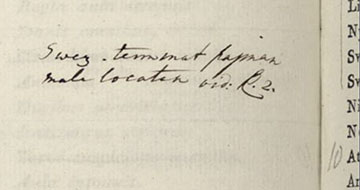
Conybeare also recognized that the penultimate leaf numbered 197 in the manuscript foliation was misplaced. Giving Thorkelin credit for printing it where it belonged, between pages 198 and 201 in his edition, Conybeare wrote on the interleaf to p. 198 pag. male collocatur in ordinem restituit Thork: (i.e. Thorkelin restored the wrongly placed folio).
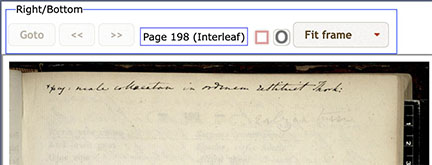
Conybeare again dutifully marked the starting words of 189A(197)r1 (feorh ealgian, p. 198) and the ending word of 189A(197)v21 (wedra, p. 201), adding on the interleaf of p. 201 folii male collocati finit, seq. 189 (the end of the badly placed folio, 189 follows). Scholars using the manuscript foliation number it 189A(197) between folios 188 and 189.
When Madden visited him at his home in Batheaston on 17 January 1824, Conybeare told him about Beowulf. To help him learn Old English he loaned him Elizabeth Elstob's The Rudiments of Grammar for the English-Saxon Tongue. A week and a half later, when Madden told him he had sent for his own copy of Thorkelin, Conybeare loaned him his own copy with permission to transcribe his collation and notes.
Madden's collations
Like Conybeare, Madden also made his collation in two stages. Unable at first to acquire an interleaved copy, Madden ordered a bound copy from Germany. He wrote in his diary that he began copying Conybeare's collation into this bound copy on 24 February 1824. Lacking interleaves, Madden had to copy Conybeare's work on the pages of the edition.
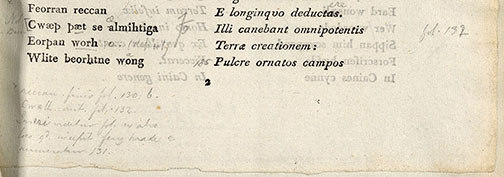
Shortly after Conybeare died on 12 June 1824, Madden wrote in his journal that he was now free to proceed with Beowulf as he pleased. After rebinding his copy of Thorkelin with interleaves, he decided to add his own collation. When he came to the misplaced folio 147A(131), he mistakenly thought he had found an omitted text in Thorkelin's edition. He therefore copied the text of the misplaced folio, recto and verso, on his new flyleaves for pages 9 and 10.
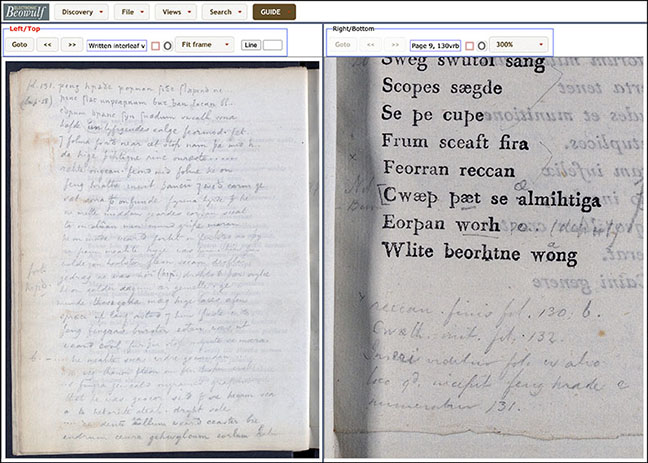
For two-and-a-half lines, Madden began copying the Old English script, then reverted to longhand. He provided a full transcription of 131r and began 131v, carefully recording how many letters were lost along the edges when he collated. He completed his transcription of 131v on the interleaf to page 10. On page 58, in addition to copying Conybeare's notes, he later added "see p. 9 addition."
Madden's collation none the less provides significant useful material, correcting Conybeare's mistakes and omissions and adding notes and occasional facsimiles of damaged readings on the interleaves. The new high-resolution facsimiles will enable serious research of this important collation.
Madden Facsimiles
Madden made a skillful tracing, now the frontispiece of his collation (Harvard University, Houghton 28286.24.3*), of the first nine lines of the 'Beowulf' manuscript.
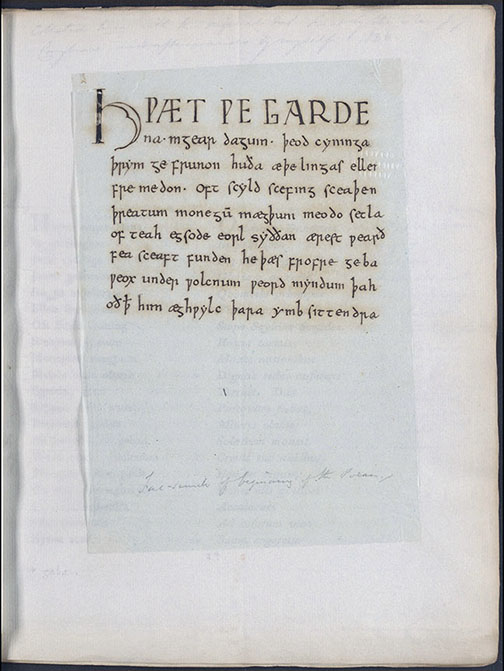
Madden also made many careful facsimiles of damaged sections of the manuscript, revealing what appeared to him the exact state of the manuscript in 1824, long before the leaves were inlaid in their protective frames.