Other Sources of the Text
Humfrey Wanley
Wanley discovered Beowulf sometime before August 1700, most likely in 1698, when he spent two months in May and June cataloguing the Cotton Library. Some scholars, misinterpreting his brief catalogue description of Beowulf, have mistakenly concluded that he could not read Old English. Anyone who studies his still indispensable Catalogus historico-criticus (1705) will find that he knew more Old English in manuscript than any of his contemporaries.
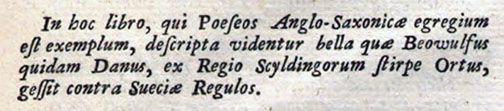
Wanley had no interest in the monsters Beowulf fought in his youth nor in the dragon he fought to the death as an old man. Wanley's interest was in the 'historical' wars Beowulf late in life fought against the Swedes. Here in his catalogue Wanley does not describe Beowulf, the son of Scyld. He describes Beowulf, the hero of the poem, as "a certain Dane from the line of the Scyldings" who fought wars against the Swedish petty kings. Knowing the Anglo-Saxon Chronicle from printed editions and manuscripts, Wanley shrewdly concluded that Beowulf the Geat was descended from the Scyldings through Scyld's greatgrandson Geat, progenitor of the Geats.
His catalogue description proves that Wanley read with keen attention the entire poem. Two of his transcriptions were published with his catalogue in 1705. These surviving tanscriptions from the beginning of the poem amount to forty lines from fols. 129r1-18 (lines 1-19) and 130r8-20 through 130v1-4 (lines 53–73).
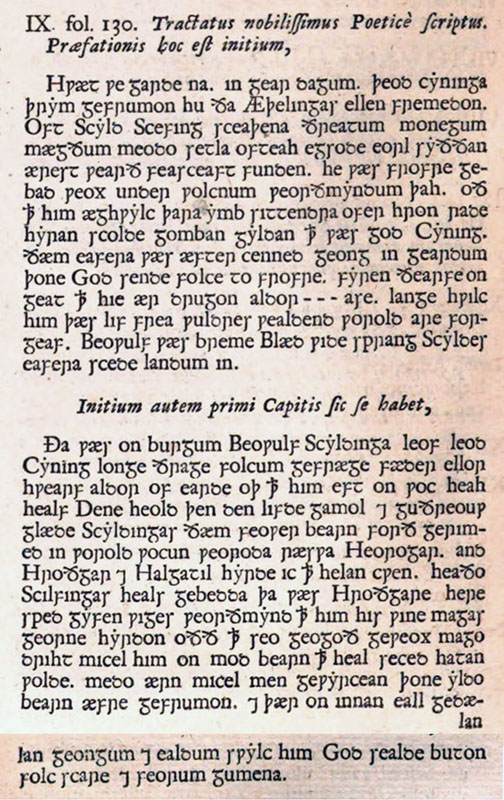
These transcriptions preserve six letters and an entire word, medo (130v1 (line 69) in line 12 (above) of his printed transcript. His confidence in Old English is evident in his lightly edited transcript, where he capitalizes important words and proper names, inserts spaces and removes them where needed, and knowingly interchanges thorn and eth. Though denied repeated requests to proofread his work, there is only one trivial error (am for un in gefrunon) in these transcripts.
Wanley's value to Beowulf studies goes beyond the restoration of medo and a half-dozen letters. His unique foliation shows there was once a blank leaf between the Southwick and Nowell codices. All of the texts in the Nowell Codex until the Judith fragment are accordingly one folio in advance of the MS foliation.
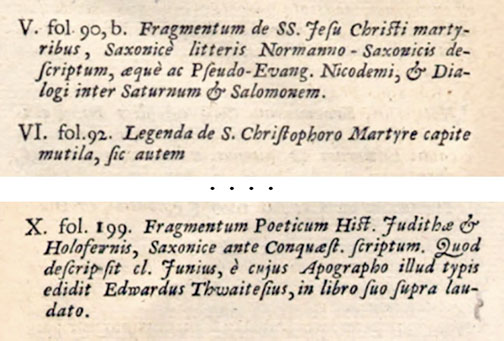
The misplaced folio 189A(197)
Before Wanley described the Nowell Codex, someone had dismembered the original Judith codex, taking away its beginning and writing in a sixteenth-century hand its final lines.
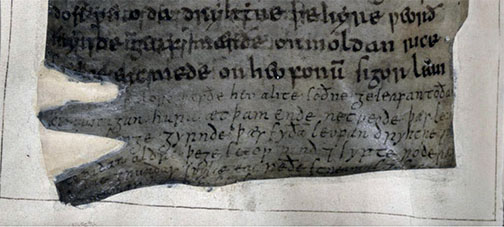
The same person must have placed the remaining Judith fragment for safe-keeping within the outside sheet of the last Beowulf gathering. Judith began on fol. 199 because the last leaf from Beowulf was then at the end of the codex following the fragment. This hypothesis explains why the last leaf of Beowulf was badly burned in the fire of 1731, and why the last leaf of the Judith fragment was protected.
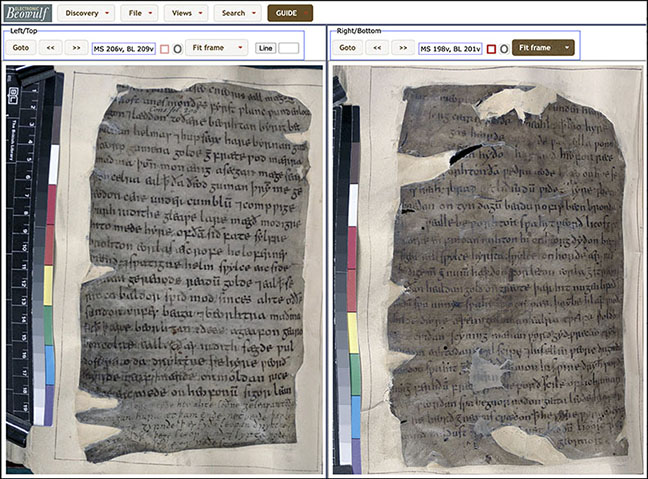
It also explains how the first outside leaf of the Beowulf gathering was mistakenly numbered 197. Now correctly placed as 189A(197), it was next to 198, when the last leaf of Beowulf was put back at the end of its manuscript and the manuscript foliation was entered in the early nineteenth century.
The Thorkelin Transcripts
Commonly known as Thorkelin A (now identified as James Matthews) and B (Thorkelin himself), the late eighteenth-century transcripts of the Beowulf manuscript alone preserve nearly 2000 letters from its outer edges that were lost by a disastrous fire in 1731. These transcripts are accordingly invaluable for the transmission and foundation of the text of Beowulf in modern times.
Because James Matthews (A) copied more than one folio of Beowulf per page, collating facsimiles of the manuscript with his transcript was always difficult. In 1983, the editor explained to Keeper of Manuscripts Svend Gissel the value of penciling in the manuscript folio numbers next to the corresponding places in Matthews (A). The Keeper agreed and authorized Assistant Keeper Kirsten Weber to write them in. Thereafter, scholars using the transcripts in Copenhagen could readily find where they were in Beowulf, because the Zupita-Davis facsimile and Klaeber (and the fourth edition in 2008) adhered to this historical foliation.
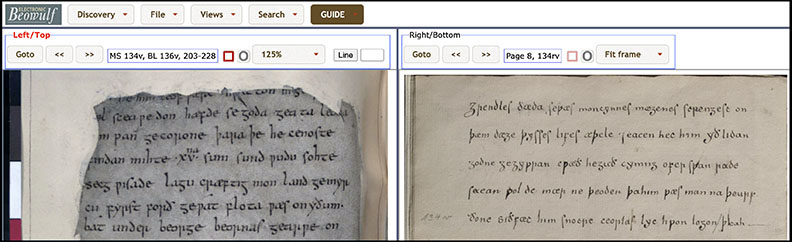
In 1994, when the Royal Library allowed the project to digitize the transcripts, anyone anywhere using Electronic Beowulf benefitted as well. Access is further enhanced in Electronic Beowulf 5.0, by setting Views in the top menu with Manuscript Left and Matthews (A) or B on the Right. In this mode, when a folio is chosen from Beowulf, the correct page in the transcript will follow.
Thorkelin A (James Matthews), 1787
Handwriting, artistic skill, availability, watermarks, and other evidence strongly argue that James Matthews, a member of the British Museum staff, made the first complete transcript of Beowulf for Grímur Jónsson Thorkelin in 1787. Matthews died in 1787, which would explain why he did not complete proofreading his work. For the details and specimens of his handwriting, see The Thorkelin Transcripts, 20–25. This invaluable transcript is now Ny kgl. Saml. 513 in the Royal Library of Denmark. A brief introduction to the use of Thorkelin A is available in the Transcripts & Collations section of this GUIDE.
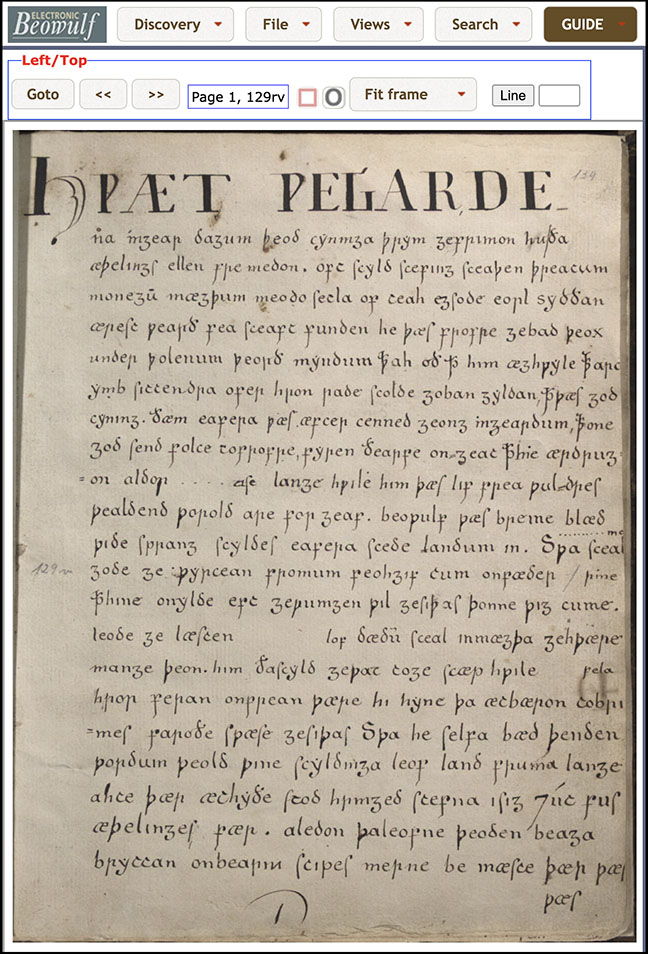
Thorkelin B (Grímur Jónsson Thorkelin), ca. 1790
Thorkelin himself made the second transcript, known as Thorkelin B, which is cataloged as Ny kgl. Saml. 512 in the Royal Library of Denmark. A brief introduction to the use of Thorkelin B is available in the Transcripts & Collations section of this GUIDE.
Thorkelin dates his own transcript in 1787, too, but there is negative evidence that he made it no earlier than 1789, most likely after April 1790, when he became assistant librarian in the Department of Printed Books at the British Museum. For details supporting a 1790 date, see Kiernan, The Thorkelin Transcripts of Beowulf (1-41, 151-55); for the less likely 1789 date, see Kiernan, "Madden, Thorkelin, and MS Vitellius/Vespasian A XV," The Library (1986), 127-32.
Thorkelin's First Edition, 1815
Among the images in Electronic Beowulf are two complete copies of Thorkelin's first edition, De Danorum Rebus Gestis Secul. III & IV. Poëma Danicum Dialecto Anglosaxonica. Ex Bibliotheca Cottoniana Musaei Britannici, ed. Grim. Johnson Thorkelin (Copenhagen: Th. E. Rangel, 1815).
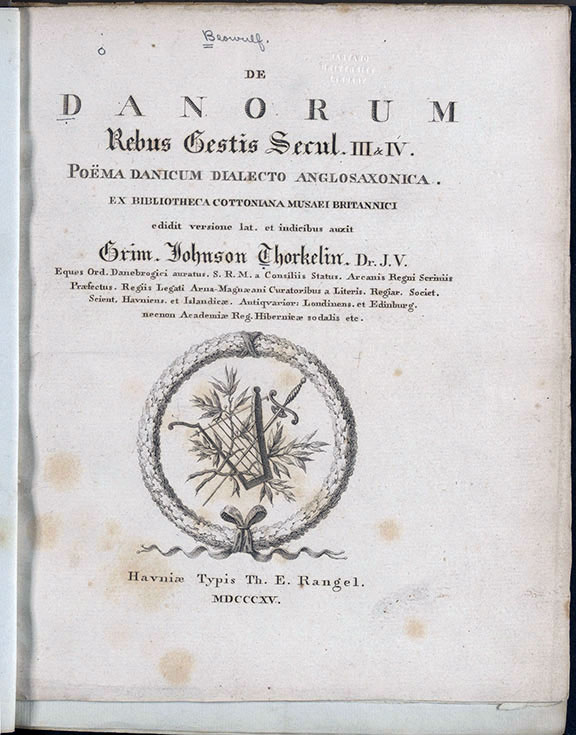
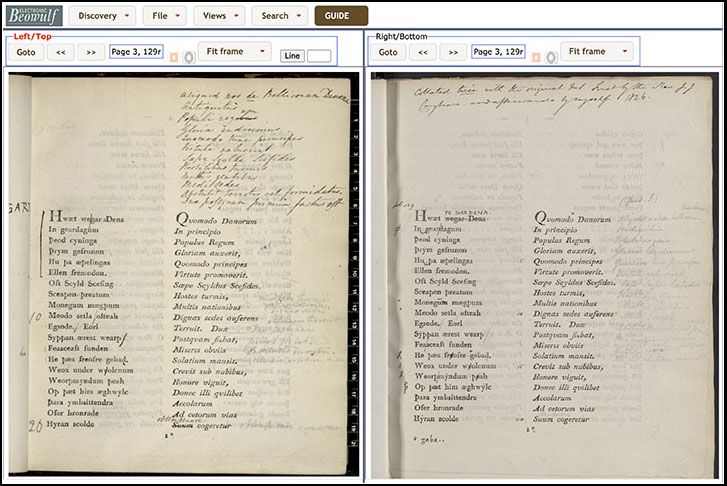
These two copies are particularly important, because they each contain nineteenth-century collations of Thorkelin's edition with the Beowulf manuscript before its fire-damaged leaves were placed in protective paper frames. The collations preserve letters that fell off during the binding process. Both copies are interleaved and frequently contain valuable notes and facsimile drawings relating to the state of the manuscript at the time of the collation. The reader may use each copy of the edition as individual books. However, for the actual collations, the reader may prefer to set them up as parallel texts through the Views > Change View facility on the main menu.
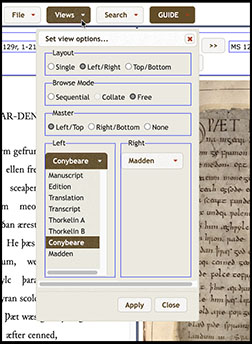
John J. Conybeare's Collation, 1817
Traveling back and forth from Oxford between 1817 and 1819, John J. Conybeare, Rawlinson Professor of Anglo-Saxon (1808–1812) and Professor of Poetry (1812–1821), undertook in his words a tedious, three-year (Tædium Trienne) collation of the Beowulf manuscript with Thorkelin's 1815 first edition. For a discussion of the value of Conybeare's collation in relation to the young Frederic Madden's, see The Conybeare-Madden Collation of Thorkelin's Beowulf." In 1994 Whitney F. Bolton generously donated Conybeare's copy of Thorkelin's edition to the British Library for use in the project.
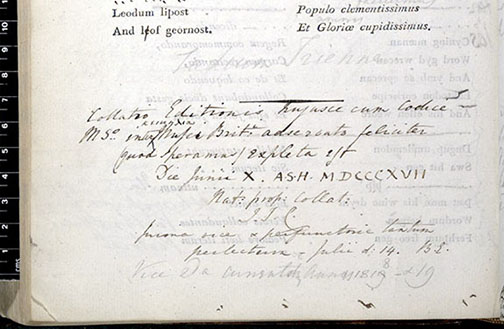
For some examples of how one might use Conybeare's collations in Electronic Beowulf 5.0, see 19th-Century Collations in this Guide.
Frederic Madden's Collation, 1826
In 2022 the Houghton Library at Harvard generously redigitized Madden's collation of the Beowulf manuscript with Thorkelin's first edition for Electronic Beowulf 5.0. The previous images of this important collation were for various reasons uneven and incomplete. Harvard has now replaced them with high-resolution images suitable for professional research.
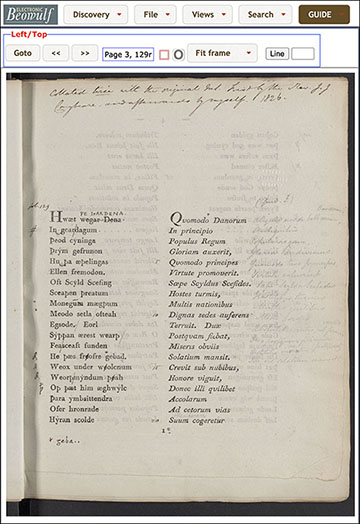
Frederic Madden was twenty-three when he met Conybeare in January 1824. Visiting him at his home in Batheaston, Madden was impressed with Conybeare’s library, marveling that it contained "every volume in Saxon literature that had ever been published, except a few pages of a Saxon homily, which he had not got." Conybeare let him borrow some books, including Elizabeth Elstob's The Rudiments of Grammar for the English-Saxon Tongue (1715), the first Old English grammar written in English.
Conybeare also loaned Madden his collation, which Madden laboriously entered into his own interleaved copy of Thorkelin. When Conybeare died five months later, Madden began his own collation within the week. On the last page Madden ungratefully mocked Conybeare's Tædium Trienne by writing Tædium quatuor hebdomadum. F.
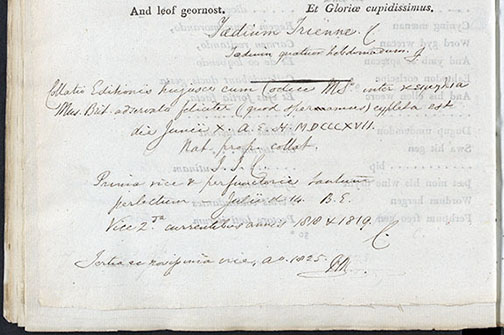
For a preliminary analysis of the value of Madden's collation in relation to Conybeare's, see "The Conybeare-Madden Collation of Thorkelin's Beowulf." On the possibility that Madden's confusion of Vitellius and Vespasian A. xv might support a 1789 dating of Thorkelin B, see "Madden, Thorkelin, and MS Vitellius/Vespasian A XV," For some examples of Madden's collations, including his facsimiles, in Electronic Beowulf 5.0, see 19th-Century Collations in this Guide.
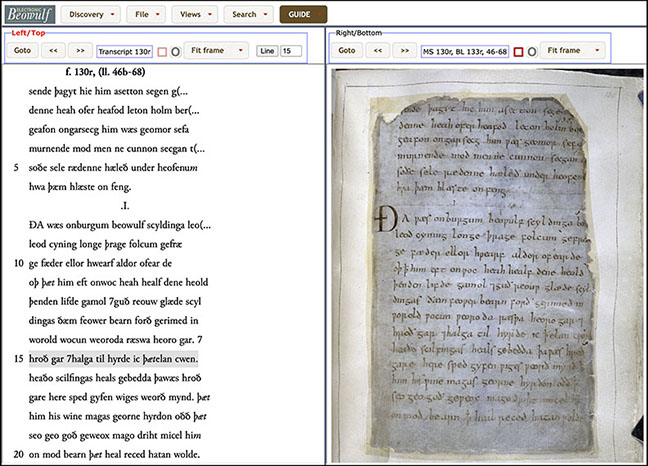
 ...) MS reading lost at left margin but supplied by A or AB.
 on the top menu bar to reveal these places and click any rectangle appearing on the folio to go to the often illustrated Textual Note.