Discovery
Electronic Beowulf 5.0 contains many tools designed to discover a very wide range of information that is normally difficult or tedious to consult: definitions, detailed parsing (including help with strong verbs), literal translations, an exhaustive glossary, lexical cross-referencing, metrical analyses of five metrists for all verses, a critical apparatus, textual and explanatory notes, eighteenth-century restorations, editorial emendations, conjectural restorations, and ease of reference to manuscript images as well as to printed editions.
Discovery Modes
To help the user take easy advantage of these resources, the new DISCOVERY button in the top menu of Electronic Beowulf 5.0 opens a menu of choices, described and illustrated in the guide below. Click any or all of the choices to activate them within the edition. Click any or all choices to deactivate them.
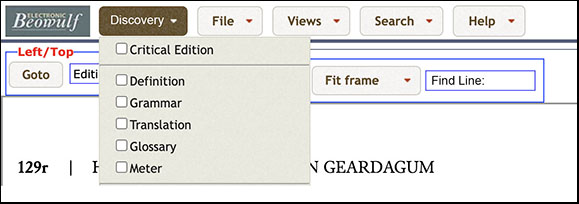
Critical Edition
Choosing Critical Edition from the new Discovery in the top menu of Electronic Beowulf 5.0 opens many ways to access the manuscript evidence. This choice releases the editorial markup identifying Thorkelin restorations, as well as editorial emendations and conjectural restorations.
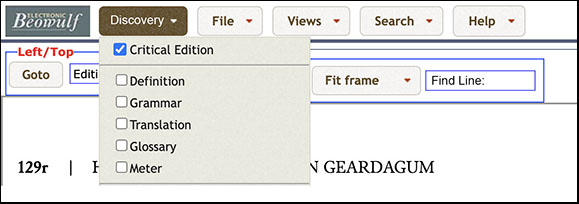
Critical Edition Sub-menu
Each menu after Studying Beowulf has a sub-menu. Topics treated in the Guide under Critical Edition include Thorkelin Transcripts, Editorial Emendations, Conjectural Restorations, Textual Notes, Backlit & Ultraviolet, Testing Restorations, and The Palimpsest.

Definition & Grammar
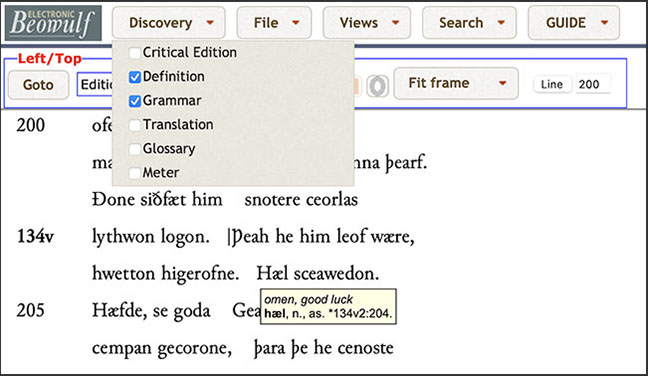
A student will want more information about individual words, and probably prefer not to have the translation intrude on this level of study. In this case the student can remove the check mark beside Translation and check instead the button for Definition or for Grammar, or for both. If both are chosen, a definition and abbreviated morphological information will appear when the mouse is placed over any word in Beowulf.
Translation
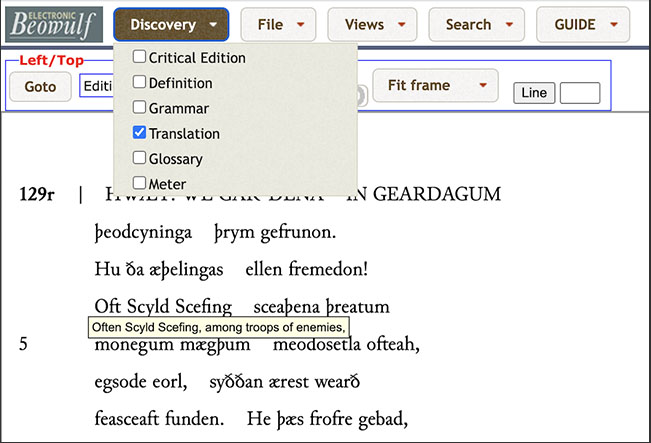
A general reader wishing to learn some Old English may choose to use the interlinear translation by selecting the Translation option. Thereafter a literal translation of any line will appear whenever the mouse is held over that line. The translation strives to a fault to observe the word order of the Old English, but uses the marker [tr] when it seems necessary to transpose the order. The translation has the modest goal of unraveling the syntax for beginners and casual readers.
For readers with no knowledge of Old English, the fifth edition now gives access (by popular demand) to a revised facing Translation. To move pages simultaneously, set view options in Views with Edition or Manuscript left and Translation right. Departures from customary translations are discussed in the Glossary and textual notes.
Glossary
The Glossary also explains issues that will appear in the Grammar tooltips. For example, it will show that onfeng is third person singular, past tense indicative, of the verb, onfon, a class 7 strong verb. A student might well want to investigate this verb and its class. By double-clicking the word onfeng in the text or by selecting the button for Glossary, the student can open the full entry for onfon in the context of the comprehensive glossary.
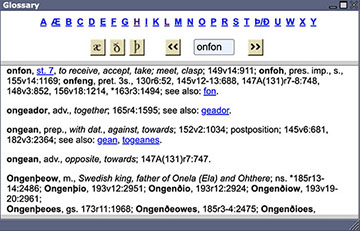
The student will learn from the cross-reference with fon that on- is a prefix, and by following the link to the base word will find that Beowulf uses six different verbs formed by prefixes with fon (befon, onfon, ðurhfon, wiðfon, ymbefon, and gefon). One can explore all of these related words and easily return to onfon and onfeng and the edition by following the links.
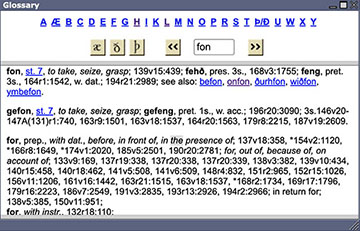
The verb gefon, class 7 strong, has an unusual infinitive form, a contraction. To understand its conjugation in the context of other strong class 7 verbs, one can click the class number to divide the Glossary window to provide other models of that class (to close this window, place the mouse on the divider and pull it down like a shade).
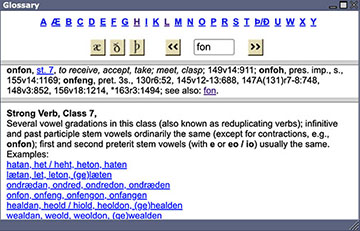
The full glossary provides a wealth of information for casual readers, serious students, and scholars. By clicking any location, which for easy reference to the manuscript always provides folio number, folio line number and verse line number, the user is taken directly to that location in the text. To keep the full glossary handy but out of the way, shrink the window:

Meter
Students may also wish to study the meter of Beowulf. The fifth edition provides comprehensive access to the scansion of all 6,368 (or in print editions 6,364) half-lines in the poem. By clicking the Meter option, the student may choose to have tooltips for any or all of the five different prevailing metrical theories.
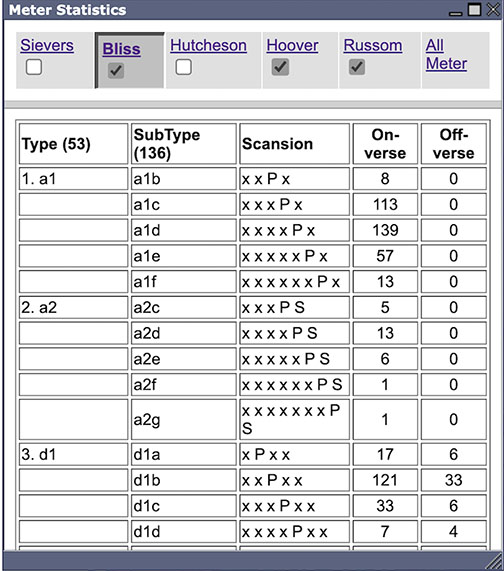
Some metrists have highly empirical, untheoretical approaches with scores and even hundreds of types, while others have elegant abstract theories with relatively few types. Students will find that even the more abstract theories often display very different interpretations of the meter of individual lines.
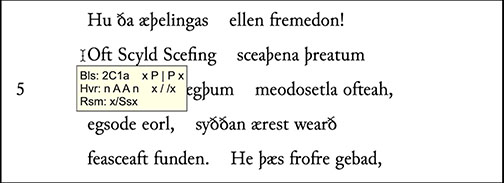
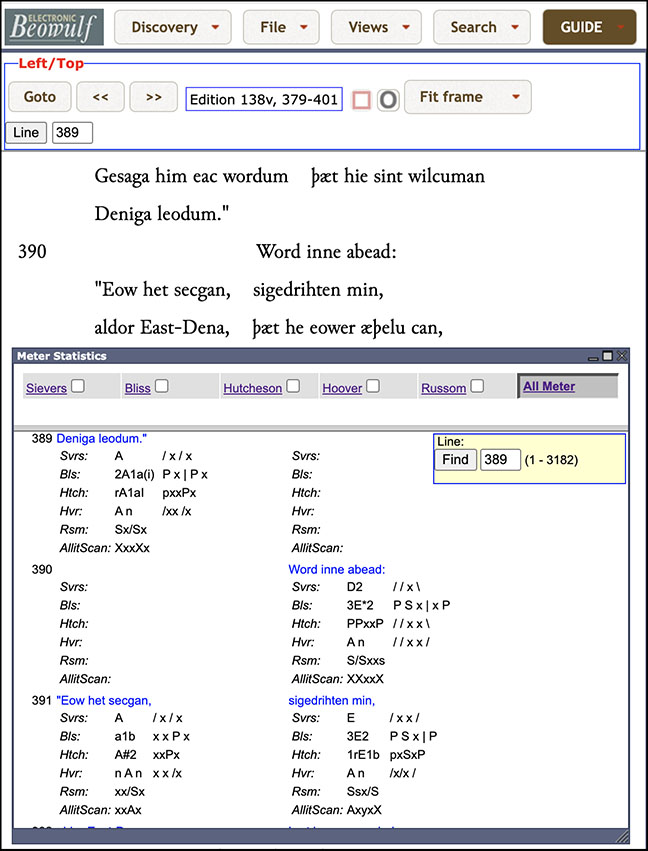
Using the tooltips, readers will also learn to what extent different metrical theories invisibly emend a great multitude of manuscript readings by suppressing or adding syllables in their scansions. If they do not want to show metrical tooltips, students and scholars can still study all the statistics of each metrist in their respective lists or open the searchable “All Meter” window for comparative views of any or all lines.
Traditional Line Numbers
The fifth edition of Electronic Beowulf uses traditional lineation to facilitate comparison with other editions of Beowulf. Previous editions of Electronic Beowulf followed an experimental lineation based on counts where half-lines and lines were missing and where hypermetric verses seemed to call for alternative distributions. These issues are now discussed in the notes to these anomalies.