The Palimpsest
For the identification of a third Beowulf scribe and a detailed analysis of the palimpsest of fol. 179, recto and verso, see Kiernan, "The nathwylc Scribe and the nathwylc Text of Beowulf." Here it must suffice to say that Julius Zupitza's "freshening-up" hypothesis to explain the highly complex condition of this folio has nothing in its favor. Editors and scholars must abandon it to understand important facts about the history of the text of Beowulf.
A "freshening-up" theory does not take into account some facts about the folio that one must confront before developing an hypothesis to explain them: (1) the condition of the vellum is napped and discolored compared to other leaves in the manuscript, particularly the leaf that should be conjugate; (2) as Zupitza first noticed, and as Tilman Westphalen exhaustively confirmed, the script of the entire text—not just some letters sometimes interpreted as errors—is somewhat different, exhibiting later features, than the rest of the second scribe's work; (3) someone has treated now illegible sections of the text with a chemical reagent; (4) an off-set from the facing leaf, fol. 178v, has in some places left reverse letters, further confusing the appearance of the text.
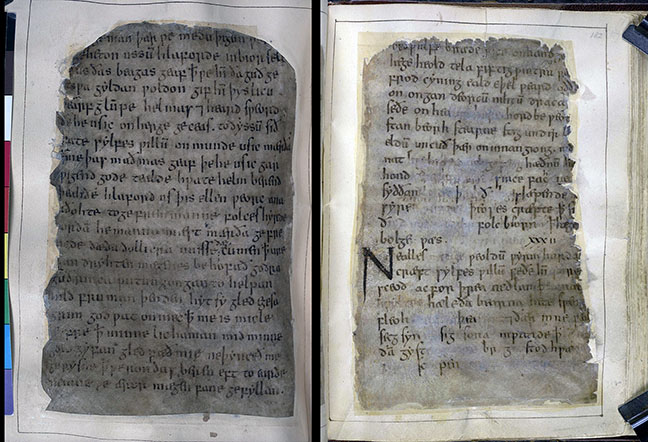
This hypothesis explains these facts: (1) the radical removal of the original text by scouring and pumicing accounts for the condition of the vellum; (2) a third scribe with a later hand than the second scribe's replaced the original text; (3) some of the new text failed to adhere to the washed vellum, which may have been lightly waxed; (4) someone in modern times tried unsuccessfully to resuscitate these areas with chemicals; (5) an off-set is unexceptional, especially under the conditions described above and considering the aftermath of the fire of 1731. The revision of a vernacular text in any era is also unexceptional.
Off-set from 178v
With 179 recto open, click the  in the top menu to open the drop-down folio menu. Choose 'Offset from 178v8-13' from the drop-menu.
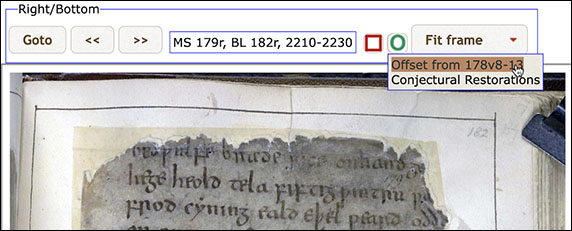
A separate window opens with an overlay of the relevant section from 178v on top of the affected area of 179r. The investigator can change the size of window, fit the folio by height or width, and increase or decrease the size of the script.
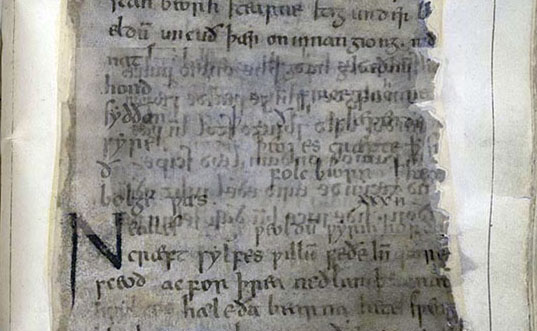
Use the slide-bar to study how the off-set image has interfered with the text on the palimpsest. The off-set was presumably caused because the palimpsesting had left this part of 179r still damp when the book was closed.
Effects of Chemical Reagent
Here (179r18–21 top, 179v1–2) and elsewhere on the folio the swabbing application of a chemical reagent in the illegible areas of the folio is evident under ultraviolet.
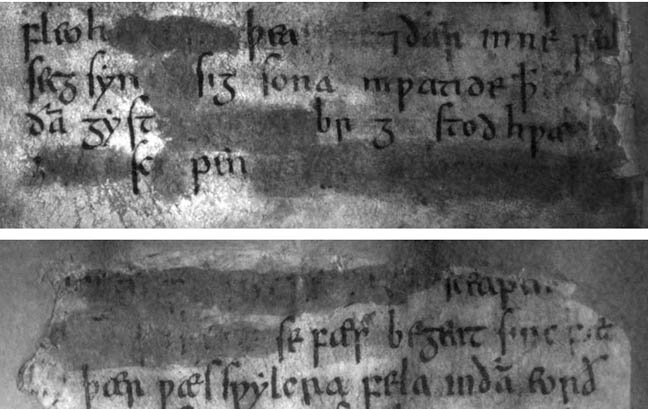
There would be no reason to apply a chemical reagent in these areas, of course, if the text were not already illegible.
Digital Restorations
Digital technology makes it possible to test the paleographical validity of conjectural restorations, to see if a proposed restoration actually fits in the manuscript space. Underlying the folio image is a completely restored text of the palimpsest, with the gaps filled in using the scribe's own letterforms from elsewhere on the folio.
To access the digital restorations go to the top menu, click the to open the drop-down folio menu, and choose 'Conjectural Restorations'. A window with an overlay image of the folio opens.
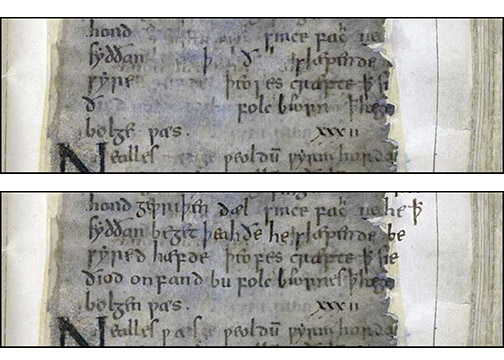
Use the slide-bar to compare the conjectural restoration with the ink vestiges, studying a restored letter, word, passage, or the entire folio. As always, one can change the size of the window, fit the folio by height or width, and increase or decrease the size of the script.