Nowell Codex
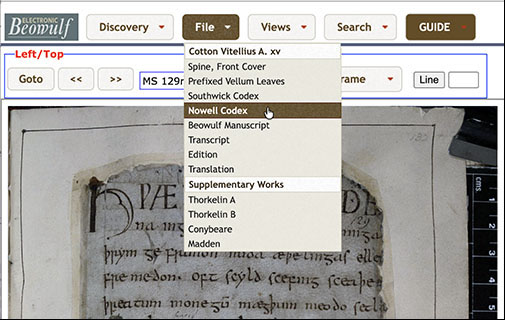
The early eleventh-century Nowell Codex, which contain Beowulf as its fourth item, is the second collection of manuscripts in BL Cotton Vitellius A. xv. To open it, go to File on the top menu and choose Nowell Codex:
The GoTo menu will then reflect the contents of the Composite codex, Cotton Vitellius A. xv, including the Nowell Codex. The name 'Laurence Nouell, 1563' in the top line gives the codex its name:
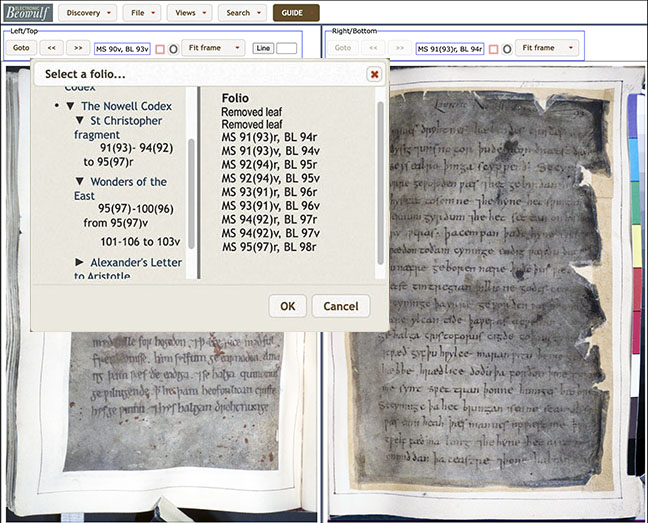
Life of St. Christopher (fragment), fols. 91(93)-95(97)r
The first folio of the Nowell Codex begins the fragmentary St. Christopher. The folio number is cited as 91(93)r to account for its current placement (91) and its former misplacement (93). See Manuscript Foliation.
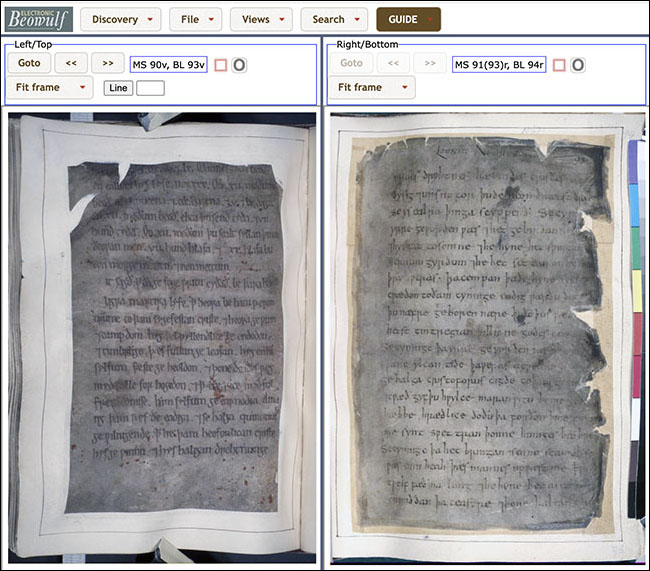
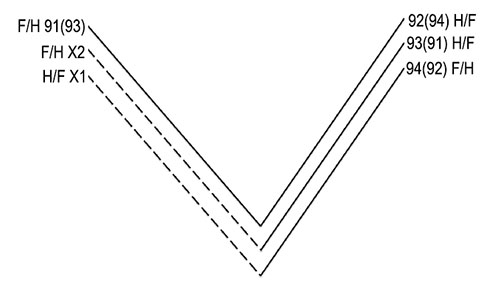
Previous editions of Electronic Beowulf treated the first ten folios of the St. Christopher fragment as a five-sheet gathering, even though three-sheet gatherings were the norm in this early part of the codex. Their wear and discoloration makes it very difficult to identify their hair and flesh construction. Most likely these folios once belonged to two three-sheet gatherings, too, with the first two leaves removed.
Little was lost from the preceding folio to judge by the incipit in BL Cotton Otho B. x, saved by Humfrey Wanley before the fire of 1731: Men þa leofestan on þære tide wæs geworden þe Dagnus se cync rixode on Samon þære ceastre þæt sum man com on þa ceastre se wæs healf hundisces manncynnes, ac he ne cuðe nan þinge to þam lyfiendan gode ne his naman ne cigde. Þa wæs him ætywed fram urum drihtne þæt he sceolde fulluhte onfon (Dearest people, in that time it happened when King Dagnus ruled in the city of Samos that a certain man came into the city who was half-dog, half-man, for he knew nothing about the living God nor invoked His name. Then it was shown to him from the Lord that he should receive baptism). All that is missing is his arrest by King Dagnus for his belief in Christ.
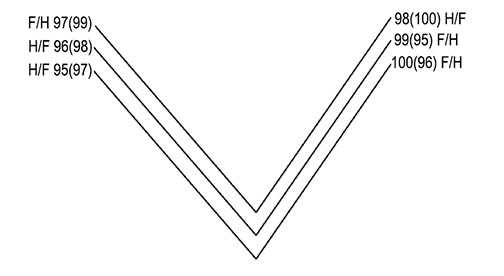
The second three-sheet gathering completes the collation of the St. Christopher fragment at fol. 95(97)r and begins the collation of the Wonders of the East at 95(97)v. For a detailed explanation accounting for the missing folios, see Kiernan, "The reformed Nowell Codex and the Beowulf manuscript," Anglo-Saxon England 46 (2019), 73-95.
Wonders of the East, fols. 95(97)v-103v
There are many illustrations, including monsters and marvels, in the Wonders. Unlike St. Christopher, its "healf-hundingas," known as "conopenas," have horses's manes, boars' tusks, and breathe out fiery flames, rather than seeking Baptism and fearlessly keeping the faith.
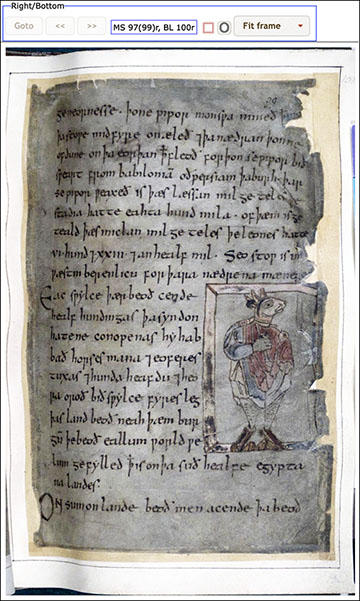
There also "beoð men acende buton heafdum, þa habbað on hyra breostum heora eagan 7 muð--hy seondon eahta fota lange 7 eahta fota brade" (men are born without heads, who have eyes and mouth on their breasts--they are eight feet tall and eight feet wide)!
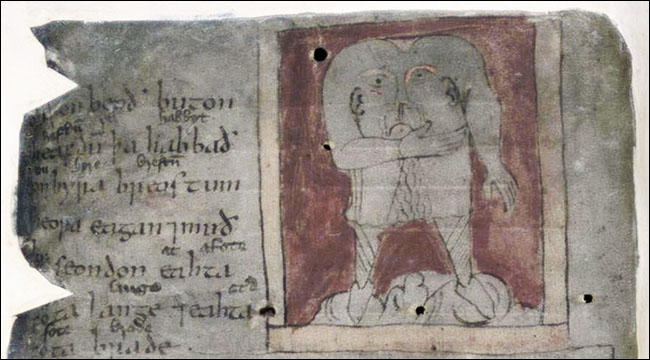
Remarkable along with the headless wonder on fol. 99(95)v1-7 are the wormholes, the rulings marked by an awl, and the Middle English glosses above the Old English text, the latter showing continuing use of the manuscript as the language changed.
Below on the same page there are depictions of two fire-breathing dragons (OE dracan) that may surprise some readers. As always, the Fit Frame button can increase the size of image or text for closer study.
In fact, the Beowulf poet uses the OE synonym wyrm for dragon over twenty times in the poem, considerably more often than draca and its five compounds combined. These dragons in Wonders are on lenge hunteontige fotmæla lange 7 fiftiges (in length one hundred and fifty feet).

There are also two types of formidable women among the Wonders (fol. 102v). The first type has beards down to their breast and dresses in horsehides. They are known as great hunters and hunt with fierce lions and tigers and lynxes instead of dogs.
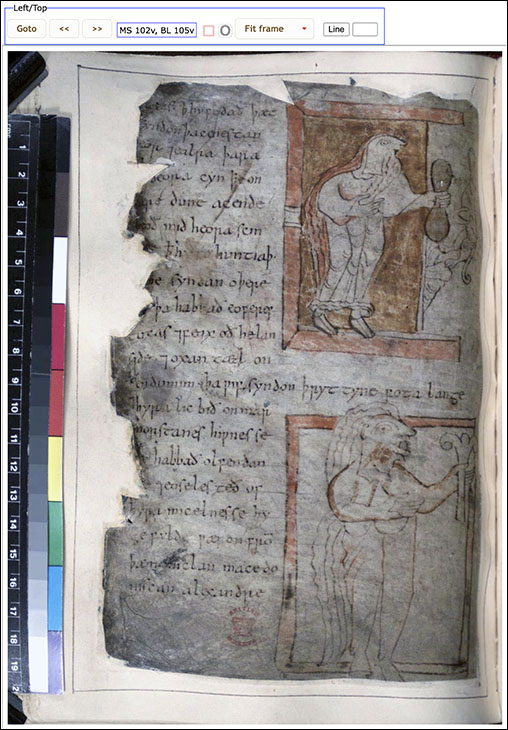
The other type of Wonderwoman is less attractive. These women are thirteen feet tall, have the teeth of an ass, boars' tusks, oxen tails, hair down to their heels, and the feet of a camel. Alexander the Great was so repulsed by their unclennesse that he killed them when he could not capture them alive.
Alexander's Letter to Aristotle
The end of Wonders and the start of Alexander's Letter to Aristotle his teacher are facing pages (103v-104). While both texts contain bizarre monsters, including "healf-hundingas," the Letter is more realistic and presents a detailed and engaging account of Alexander the Great's leadership and conquests geond middangeard (throughout middle earth, the world) (104v7).
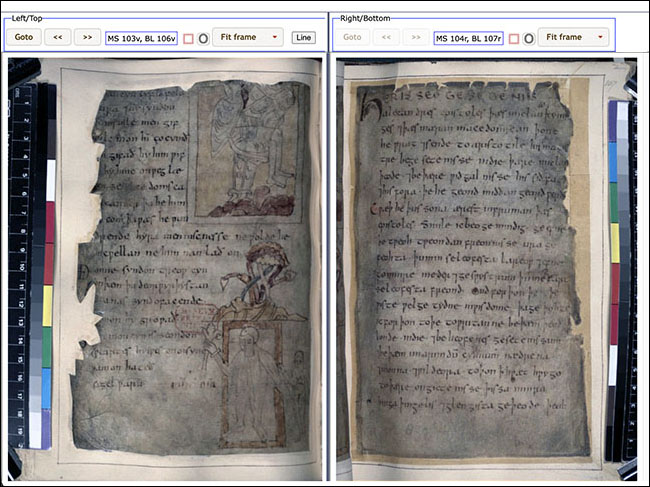
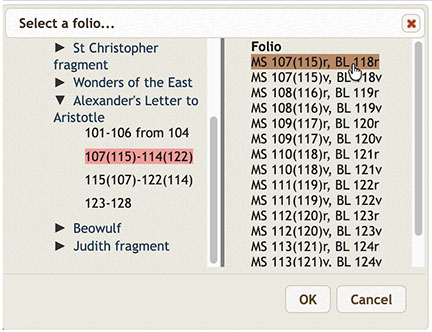
After the manuscript was rebound in 1845 with protective paper frames, two entire gatherings of the Letter (MS fols. 107-114 and 115-122) were reversed and out of place. In 1884 a staff member at the British Museum wrote a different foliation throughout Cotton Vitellius A. xv on the paper frames. Later, someone else used these 1884 numbers on the frames to explain the proper order of the gatherings, but they remain out of order today.
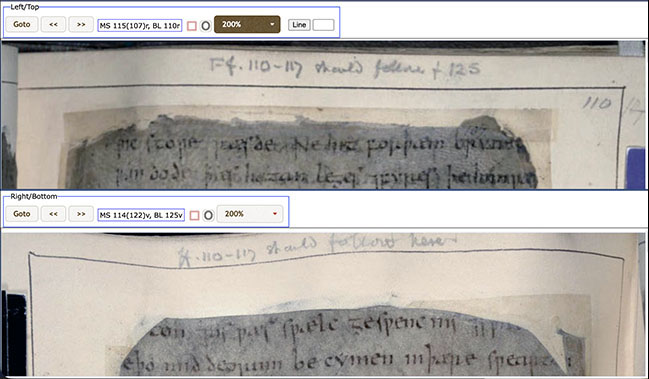
Already in 1882 Julius Zupitza had used the manuscript foliation, which major scholars and editors of Beowulf have accordingly followed. The Electronic Beowulf displays the folios in their proper sequence, using the manuscript folio numbers in the correct order with their incorrect order in parentheses.
There are many intriguing comparisons between the Letter and Beowulf, including fights to the death with wyrmas, fire-breathing dragons. Hæfdon hie þa wyrmas þrie slite tungan 7 þonne hie eðedon þonne eode him of þy muðe mid þy oroþe swylce byrnende þecelle. Wæs þæra wyrma oroð 7 eþung swiðe deaðberende 7 æterne 7 ... monige men swulton. Wið þissum wyrmum we fuhton leng þonne ane tide þære nihte 7 hie þa wyrmas acwealdon xxxtig monna þæra fyrde 7 minra agenra þegna xx.
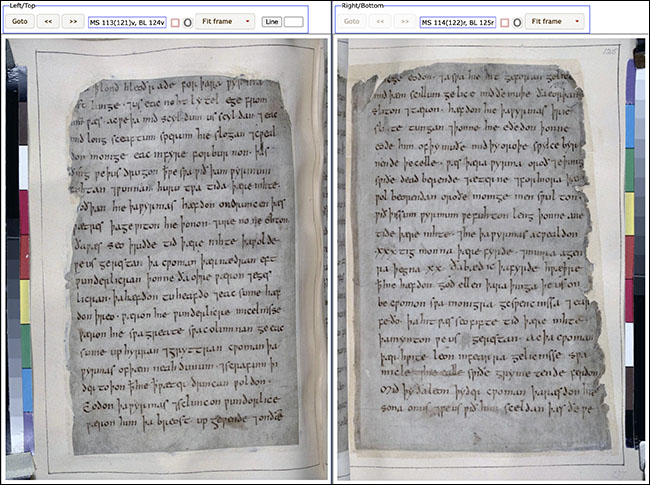
(These dragons had three-forked tongues and when they exhaled then from the mouth breath flew out like a burning torch. The breath and breathing of those dragons was deadly and poisonous ... and many men died. We fought with these dragons more than an hour that night and the dragons killed thirty men of the expedition and twenty of my own thanes).
Beowulf
With the Nowell Codex open as a manuscript book, the last page of Alexander's Letter faces the first page of Beowulf in the Nowell Codex. Similarly concerned with his fame, Alexander ends his letter to Aristotle with sentiments reminiscent of the ending of Beowulf, while also setting a model for all þeodcyningas.
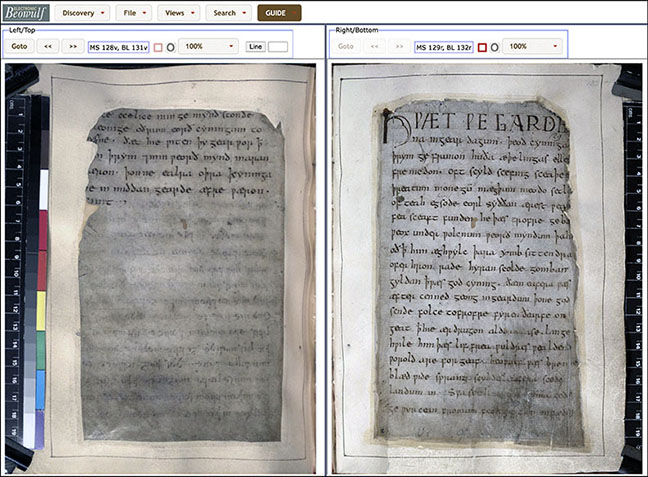
He ends his letter, "...min gemynd stonde ond [h]leonige oðrum eorðcyningum to [b]ysne, ðæt hie witen þy gearwor þ[æt] [mi]n þrym 7 min weorðmynd maran [w]æron þonne ealra oþra kyninga [þ]e in middangearde æfre wæron" (may my memory stand and rest as an example to other earthly kings, that they may know very well that my greatness and record of worth were more than all other kings that ever were in the world) (128v1-6).
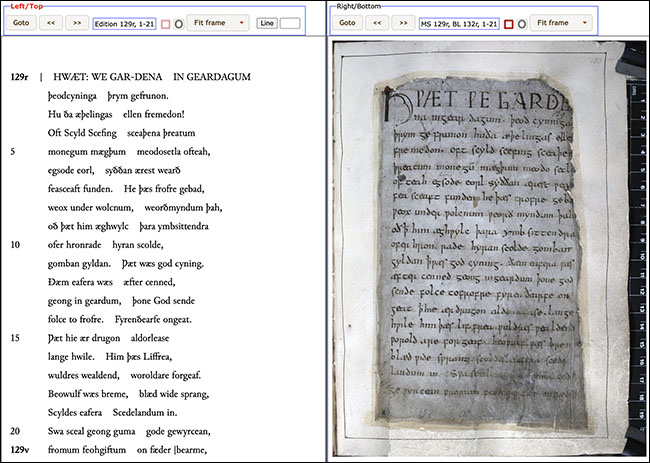
When viewing the Beowulf manuscript in conjunction with the edition, the default setting is with edition on the left and manuscript pages, recto and verso, on the right. For a thorough introduction to the uses of the manuscript with the image-based edition, see Studying Beowulf.
The Judith fragment
The beginning and original ending of Judith are gone, but scholars now seem to agree that nearly the entire text is preserved on the single surviving gathering, fols. 199-206v. As with other texts, its physical construction may be examined using the Collate feature: fols. 202v-203, for example, formed the inside of the innermost sheet of this gathering.
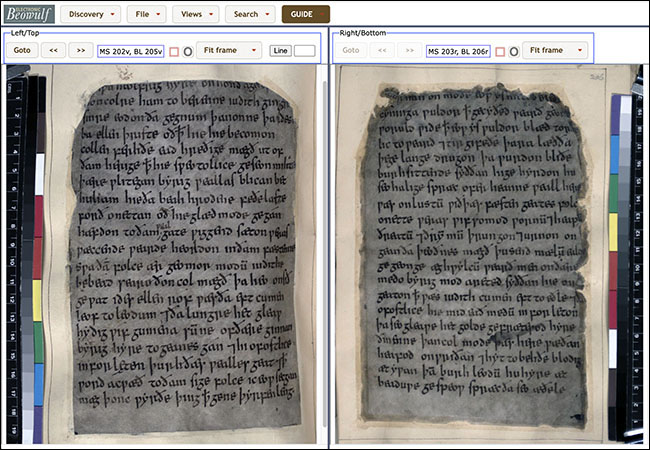
Corroborating evidence indicates that Judith, though written in the same monastic community by the same Beowulf scribe, once belonged to a different codex. Not much is missing from the beginning, yet the parts that survive, numbered X, XI, XII, and the capital H's (fols. 199 and 202), are all in a style quite unlike fitt numbers and initials in Beowulf.
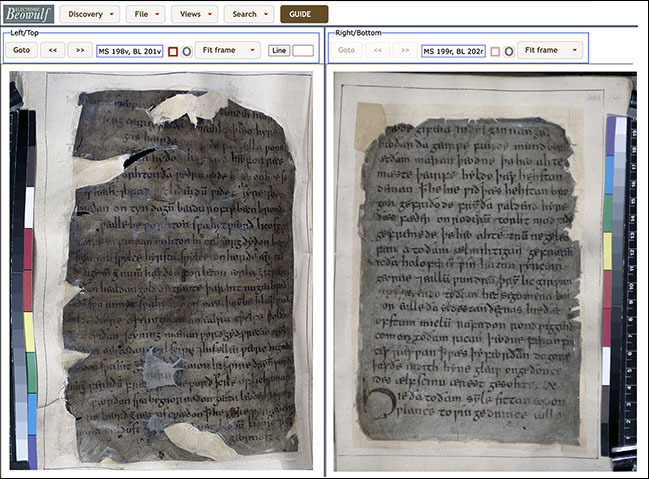
As independently confirmed by Claire Breay, Head of Ancient, Medieval and Early Modern Manuscripts at the British Library, the writing grids from top ruling to last in the preceding two gatherings of Beowulf are measurably longer than those for Judith.
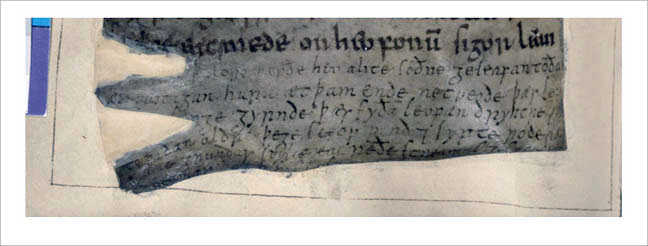
An early-modern hand supplied the last lines in Judith, proving that the following gathering was intact when Judith was pulled from the rest of its original codex following the dissolution of monasteries.