Southwick Codex
Select Southwick Codex in File to open the first collection of Cotton Vitellius A. xv. Use Goto to select an opening in the book, here the second folio recto of the late 12th-century manuscript of the Soliloquies of St. Augustine.
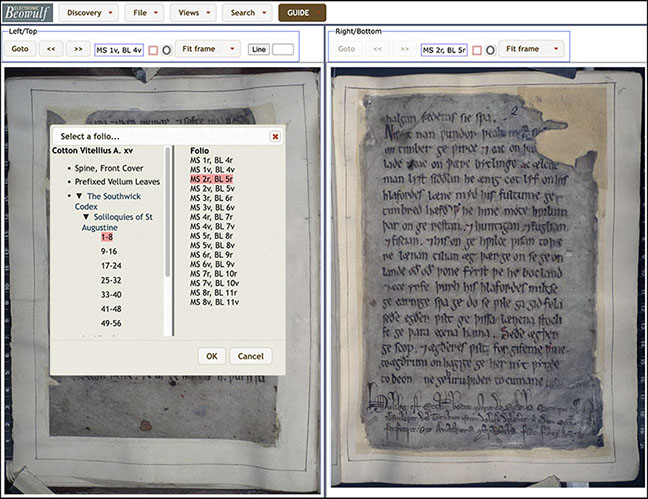
Soliloquies of St. Augustine
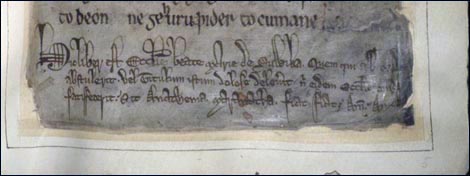
The name Southwick Codex comes from a signature of ownership written later on the bottom of the second folio recto of the Soliloquies ('Hic liber est Ecclesie beate Marie de Suwika....').
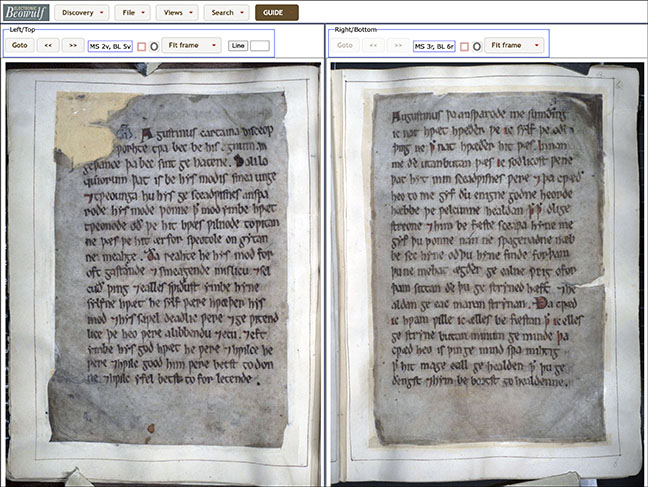
On the verso the opening nine lines briefly describe the theme: Augustinus cartaina bisceop worhte twa bec be his agnum ingeþanc. Þa bec sint gehatene Soliloquiorum, þat is, be hys modis smeaunge 7 tweounga hu hys gesceadwisnes answarode hys mode þonne þ[æt] mod ymbe hwæt tweonode oð þe hit hwæs wilnode to witanne þæs þe hit ærfor sweotole ongytan ne meahte. (Augustine bishop of Carthage wrote two books about his own conscience. These books are called the Soliloquies, in other words, about his mind's inquiries and doubts, how his Reason answered his Mind when it doubted anything or wanted to know about something that it formerly might not clearly understand.)
Although the manuscript dates from the twelfth century, the translation of the Soliloquies dates from the late ninth or early tenth century, when Alfred the Great was assembling translations of texts he considered important for his subjects to read. The translation is thus attributed to King Alfred by name in an unfinished colophon ('[H]ær endiað þa cwidas þe ælfred kining alæs of þære bec þe we hatað on...'. ):
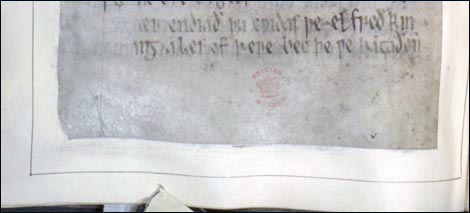
The following pages are gone, but the sentence presumably ended with something like, 'læden Soliloquiorum Augustini' (Here end the discourses that King Alfred took from the book that we call in Latin Soliloquiorum Augustini).

The fragmentary end of the Soliloquies (fol. 56v) faces the fragmentary start of the Gospel of Nicodemus (fol. 57r) in two intact gatherings. As little is missing from either text, at least one lost (or extracted) gathering with a different text must have once intervened.
Gospel of Nicodemus (fragment)
Widely popular until the end of the Middle Ages, the Gospel relates the Passion, Death, and Resurrection of Christ and his Harrowing of Hell. According to the version in CUL MS Ii. 2. 11 (173v), about a page is missing at the beginning. The text begins with the words 'hyne cuman hyder to foran þinū dom setle. / 7 hlyst hys worda', '[order] him [Christ] to come here in front of your judgment seat and listen to his words.'
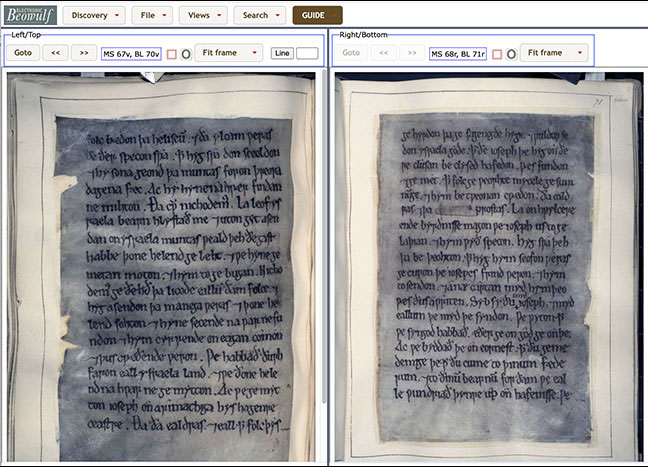
As these facing pages from Nicodemus show, the texts in the Southwick Codex have suffered much less fire-damage than those in the Nowell Codex. The fragment ends on fol. 83v13-14 with the words, 'Sy dryhten lof 7 deoflum seorh a to worulde, AMEN' (Let there be praise to the Lord and misery to devils forever).
Solomon and Saturn
The prose Solomon and Saturn begins in the next line, fol. 83v15-16, with the words, 'Her kið hu saturnus 7 saloman fettode ymbe heora wisdom' ('Here it is made known how Saturn and Solomon disputed over their wisdom').
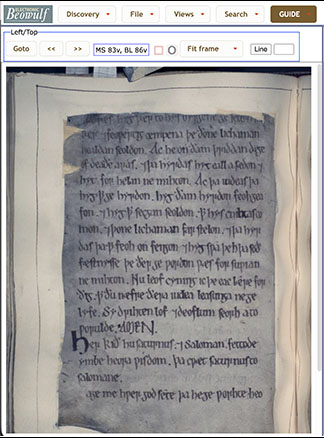
Saturn asks a barrage of questions mostly relating to the Old Testament, from how old and how tall Adam was when God made him to why the sea is salty. Solomon replies with quick, precise, esoteric knowledge. Toward the end Saturn asks who first used letters, and Solomon surprisingly widens the cultural scope by saying it was Mercury the giant.
St. Quintin Homily (fragment)
The fragmentary St Quintin homily occupies only the last eleven lines of fol. 90v. It begins at line 8, following the conclusion of Solomon and Saturn. A large initial H was never written in the space provided for it at the start of lines 8-9.
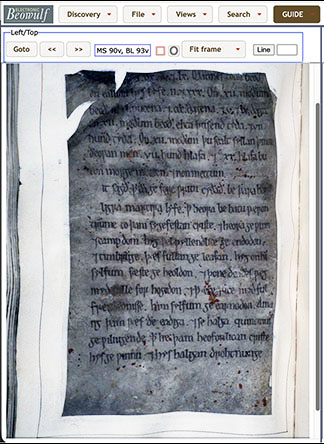
St Quintin ('se halga quintinus') is mentioned in line 16. Rustmarks from a previous binding on this page, the last in the Southwick Codex, show that the homily was already a fragment when Cotton Vitellius A. xv was compiled.