Edition Search: Apparatus
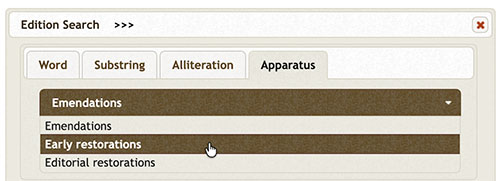
Select 'Apparatus' on the toolbar to access exhaustive information on emendations, early restorations, and editorial restorations. Then click 'Emendations' to open the drop-down menu.
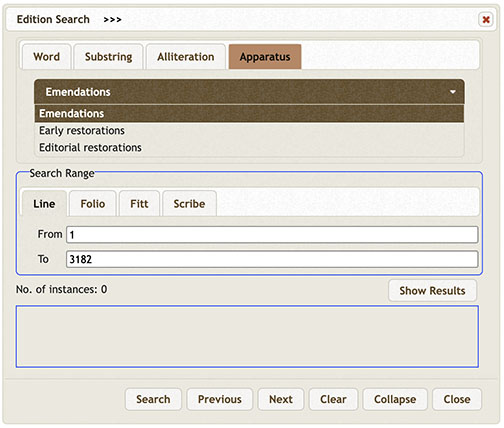
Emendations
Emendations are changes or rejections of readings that can be clearly seen in the manuscript, but for various reasons seem to require editorial correction. Click 'Search' to retrieve all emendations in line context. The Search finds 96 emendations.
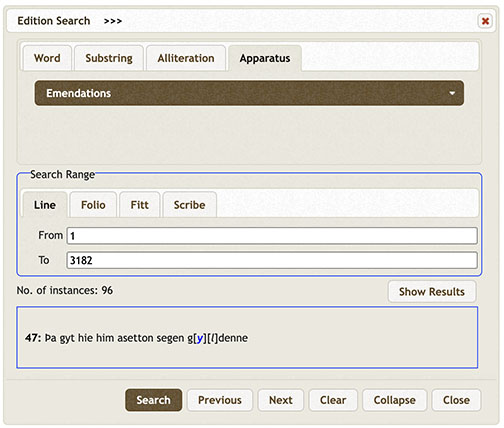
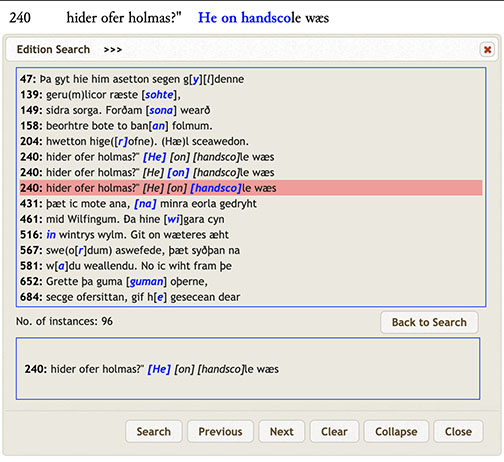
Click 'Show Results' for a complete list for all Lines, 1-3182. As always, you may limit the Search to specific ranges of Lines, Folios, Fitts, and by specific Scribe. Double-click any result to go to that line in the Edition.
Early Restorations
Lost or illegible text, which is usually caused by fire-damage, is often 'restored' by the eighteenth-century Thorkelin transcripts (A and B), which were made after the Cottonian Library fire of 1731. Humphrey Wanley, who used the MS before the fire, made transcripts of fol. 129r1–18 (lines 1–21b) and fols. 130r8–20 and 130v1–4 (lines 53–73). His transcripts restore six lost letters, confirms one damaged word, and is the sole source for another lost word.
The eighteenth-century Thorkelin transcripts and the early nineteenth-century collations of J.J. Conybeare and Frederic Madden are the primary sources of the early restorations of the fire-damaged Beowulf manuscript. Click 'Emendations' and scroll to 'Early Restorations'.
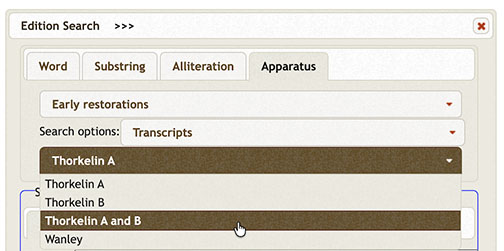
From the 'Transcripts' drop-down menu choose Thorkelin A, Thorkelin B, Thorkelin A and B combined, or Wanley to access their restorations.
Fitt (Edition or Transcript)
Using the multiple functions of 'Transcript Search' in combination, a significant number of specific features can be searched. In addition, using the 'FolioLine' references in the search results in conjunction with a split screen view of 'Transcript' and 'Beowulf Manuscript', one can examine the searched feature in the manuscript itself as well as access more information by clicking an applicable image map.
For example, select 'Additions', then 'Comprehensive'. Highlight 'Fitt' and select Fitt XXXVIII for the entire range to find additions only in that fitt. Click 'Search'.
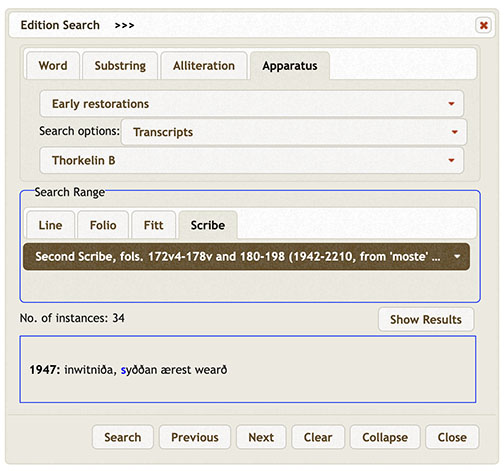
A search with the same scribal parameters under Collations reveals that Madden is behind the confident restoration of the word hwearf, where Thorkelin A wrote hweir and Thorkelin B wrote nothing.
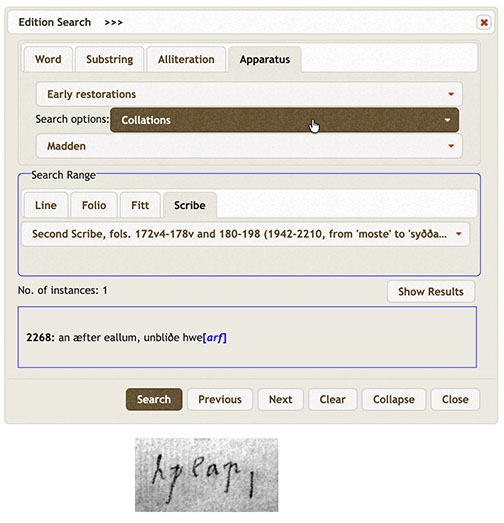
Madden supplied this facsimile drawing that shows a descender following the r (see also textual note).
Innovative searches of these now easily accessible early restorations, all provided before the manuscript leaves were restored in paper frames, are bound to lead to new insights about the text of Beowulf.
Editorial Restorations
Editorial restorations are conjectural attempts to recover readings lost to the manuscript by some kind of damage, usually fire-damage along the edges.
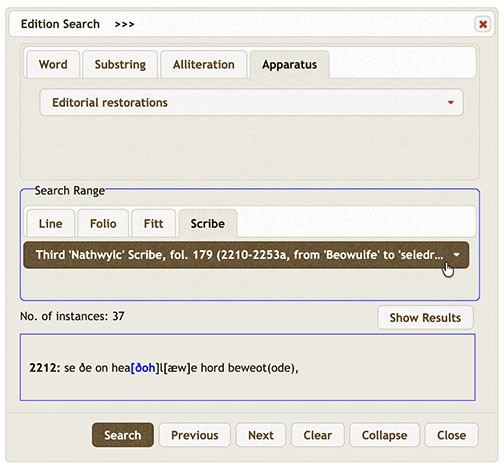
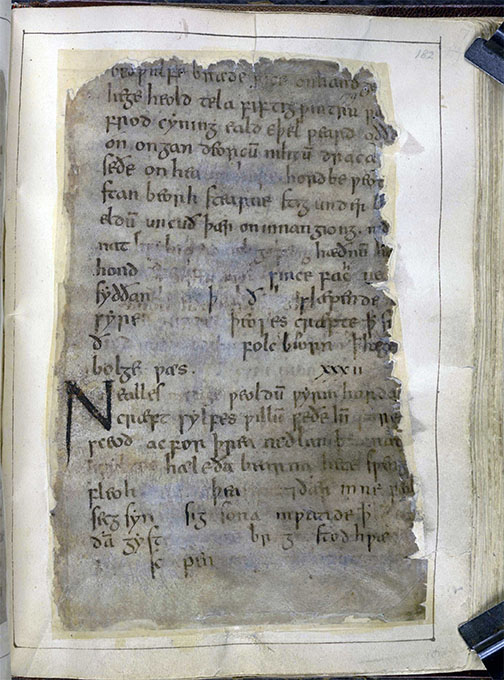
The most extensive area requiring conjectural restoration is the palimpsest of both recto and verso of fol. 179, where 37 readings required restoration in this Edition.
Many time-honored conjectural restorations can be shown not to fit in the manuscript. For a discussion, see Testing Conjectures and the textual notes.
There are some digital conjectural restorations accompanying their respective folios. These conjectural restorations are signaled when the O-button on the top menu is green: 
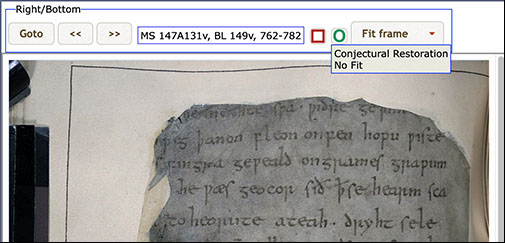
Click on the folio number to release a drop-down menu with 'Conjectural Restoration' and, sometimes, 'No Fit', for traditional conjectural restorations that do not properly fit in the manuscript.
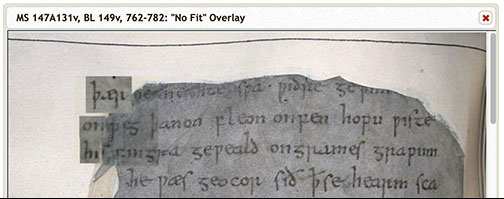
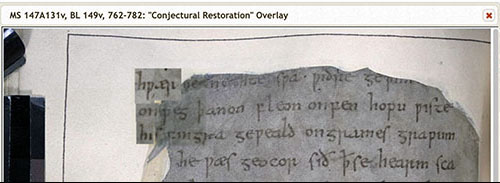
Manuscript spacing along the edge based on undoubted restorations by Thorkelin A and B in lines 2-3 provides convincing evidence that the lost reading at the start of line 1 was Thorkelin's late guess, hwær, rather than the usual editorial restoration, þær: