Details of Transcript Searches
Abbreviations
This feature allows 'Comprehensive' searches for all scribal abbreviations or searches by specific 'Type' of abbreviation.
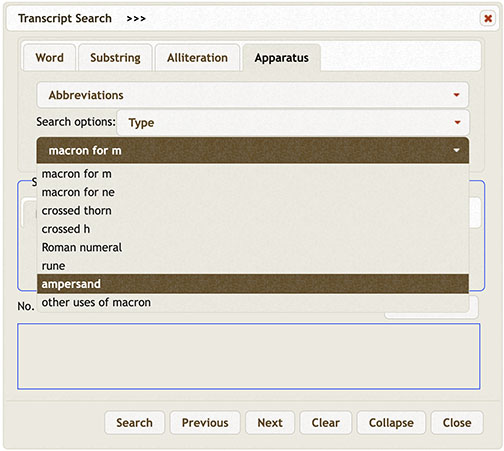
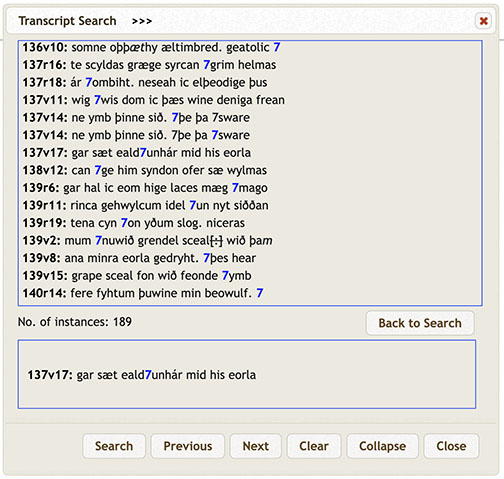
The types are macron for m, macron for ne, miscellaneous uses of macron, crossed thorn, crossed h, roman numeral, rune, and ampersand. There are 189 instances of the ampersand.
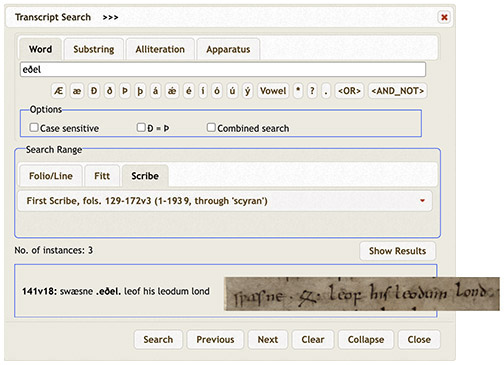
A search for rune reveals three instances of the word eðel represented by the eðel-rune
Accented Letters
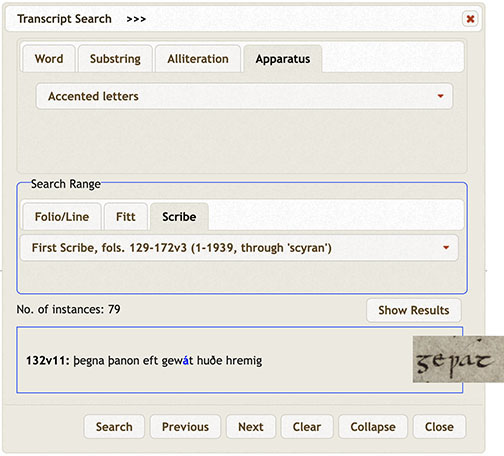
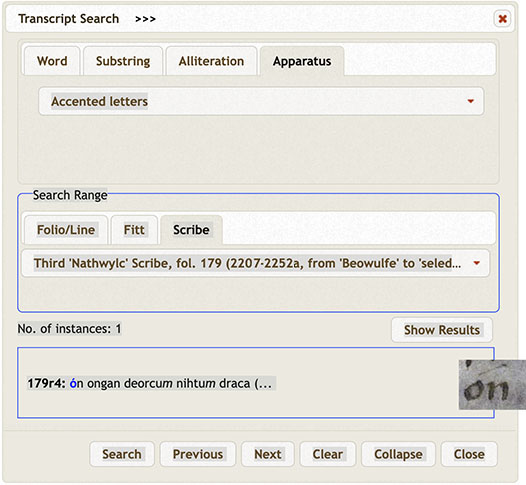
This feature retrieves all words with acute marks. The Search interface makes it easy to compare usages among the scribes.
The first scribe:
The second scribe:
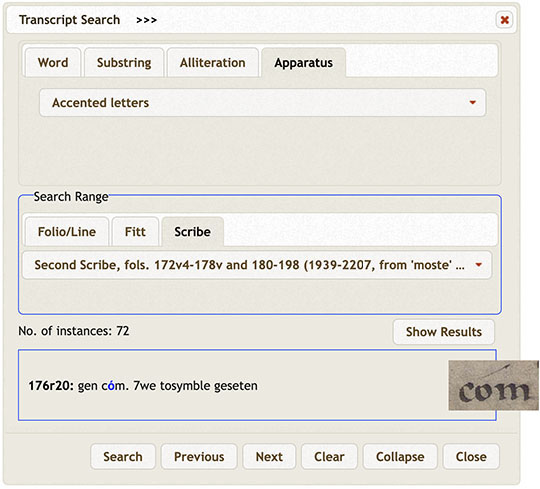
The 'nathwylc' scribe on fol. 179(182):
Additions
Additions are generally later corrections made by one or another of the three scribes. One may enter a comprehensive search of all additions, or a search for a specific scribe.
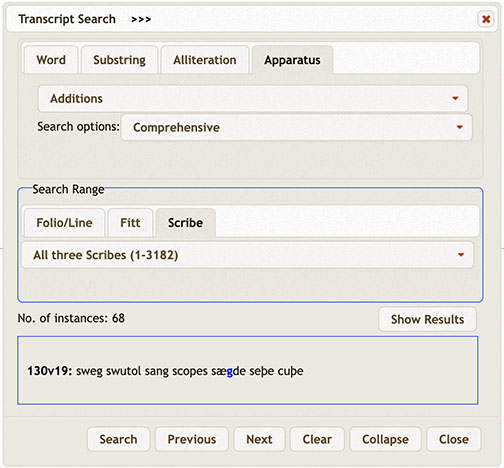
In this comprehensive search of the entire poem, the scribes made 68 additions. Scribal additions are recorded by MS folio and line number with the addition highlighted in the line. A full list appears with Show Results
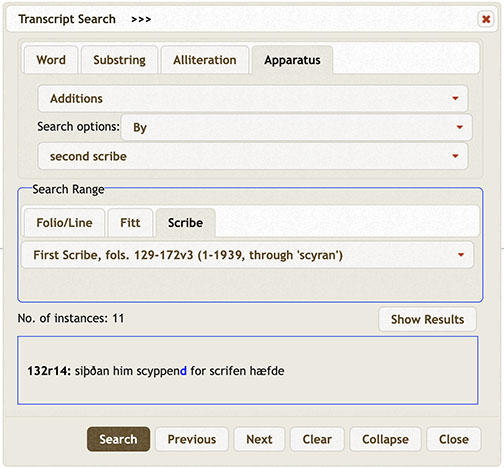
In a more specific search one can, for example, look for cases where the second scribe made an addition to the first scribe's work. This happened eleven times. In the first case, the second scribe added a d to the first scribe's reading of scyppen.
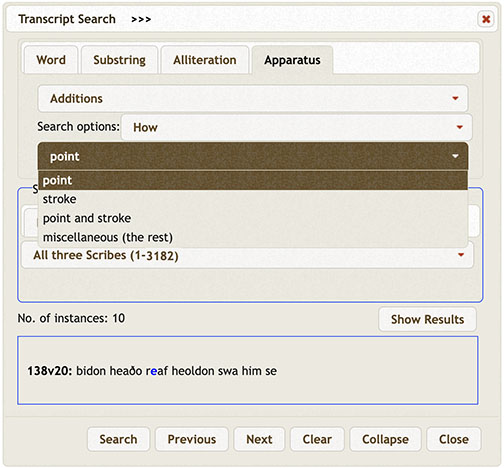
The apparatus allows one to search how a scribe signaled an addition, by point, stroke, point and stroke, or some other means.
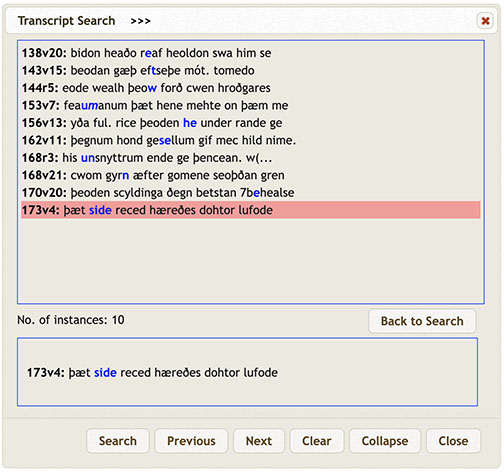
This is an important feature, because in this case only the first scribe uses a point. Show Results strongly suggests that the non-alliterating addition of side at 173v4:1981a was made by an unidentified hand, not by the second scribe. An emendation is justified.
Alterations
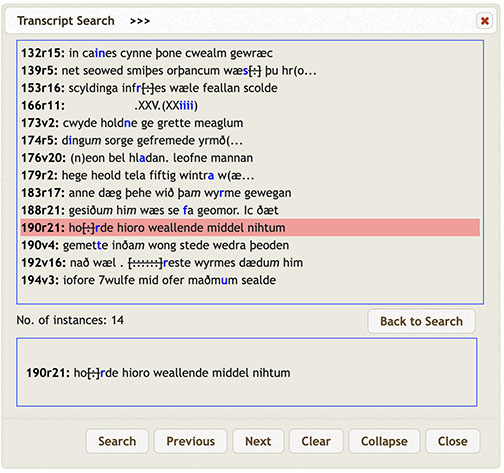
Scribal alterations are recorded by MS folio and line number, followed by the line itself with the alteration highlighted. This search was 'comprehensive,' including all types of alterations, but limited to the first scribe.
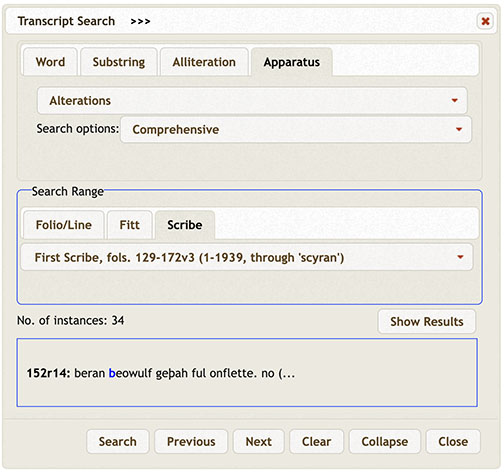
This result shows that the b of beowulf was altered at 152r14. The textual note for this line explains that b was altered from f, because the scribe started to write feoh by eye-skip to line 15.
In 14 cases ultraviolet is helpful in identifying the nature of later alterations.
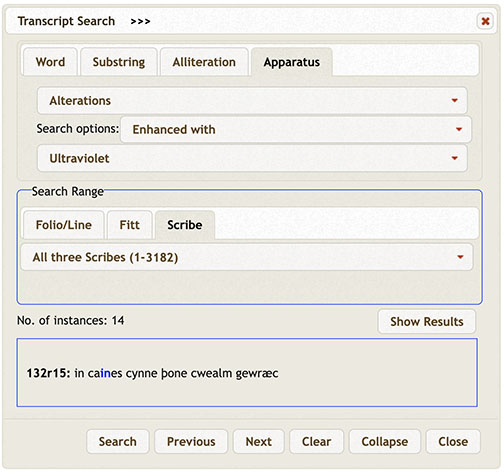
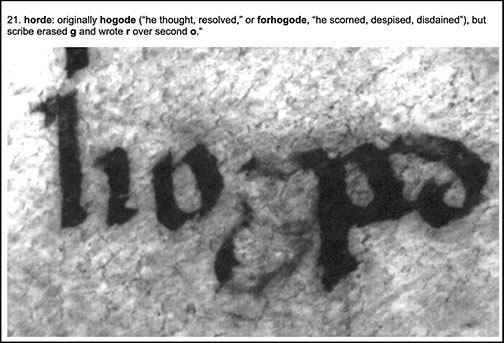
These results are discussed and illustrated in the textual notes, linked to the Edition and the Manuscript images.
Covered and Partly Covered Letters
These searches return comprehensive lists of letters and parts of letters covered by the paper frames but disclosed by fiber-optic backlighting. For details see the notes and illustrations for individual folios.
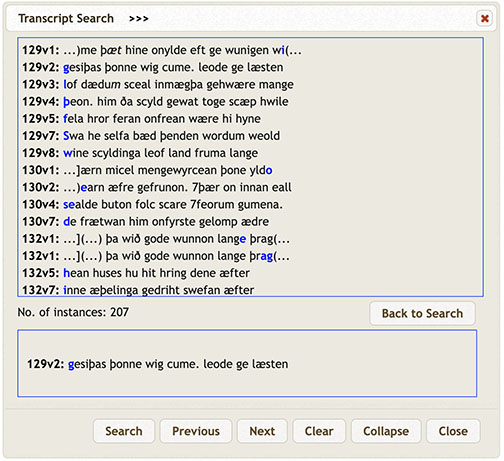
A search for covered letters limited to the first scribe returns 207 covered letters. One can investigate any of these results by using GoTo to open its folio, in this case MS 129v.
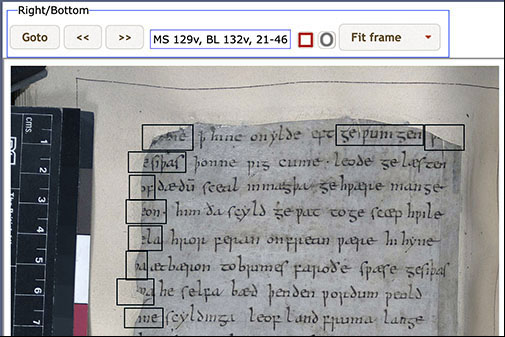
Clicking the red box  in the top menu of the MS image identifies textual notes, many of which include images enhanced by fiber-optics and ultraviolet.
Fiber-optic backlighting of fol. 129v2 shows that covered and partly covered ge in gesiþas in fact survives nearly intact.
in the top menu of the MS image identifies textual notes, many of which include images enhanced by fiber-optics and ultraviolet.
Fiber-optic backlighting of fol. 129v2 shows that covered and partly covered ge in gesiþas in fact survives nearly intact.
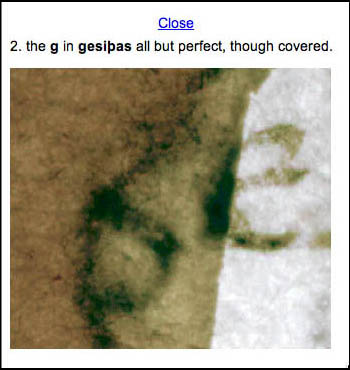
For the first use of fiber-optics in the discovery of hundreds of letters and parts of letters hidden by the nineteenth-century paper frames surrounding each folio, see Kiernan, “The State of the Beowulf Manuscript, 1882–1983,” Anglo-Saxon England 13 (1984), 23-42; reprinted as an appendix to the 1996 revised edition of Beowulf and the Beowulf Manuscript.
Damaged Letters
This feature retrieves instances of the more than 810 letters that have crumbled away, are torn, or are marred by holes.
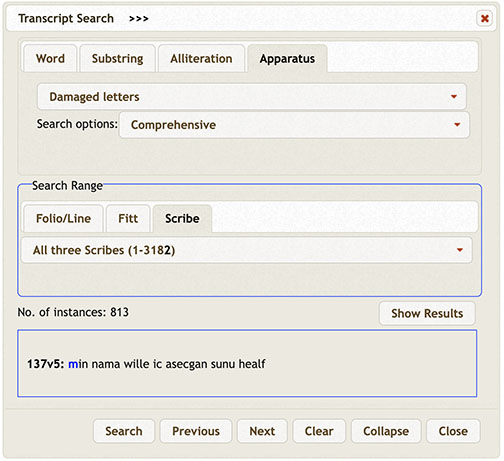
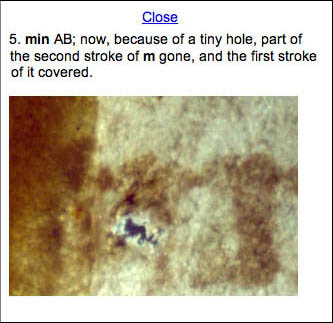
This result indicates that at 137v5, the m in min is damaged. Opening the folio and clicking the will lead the reader to a marginal note with the backlit image, showing that the second stroke of m is damaged by a hole.
A limited search of the second scribe's section under 'Enhanced with ultraviolet' retrieves ten instances of damaged letters enhanced or restored with UV.
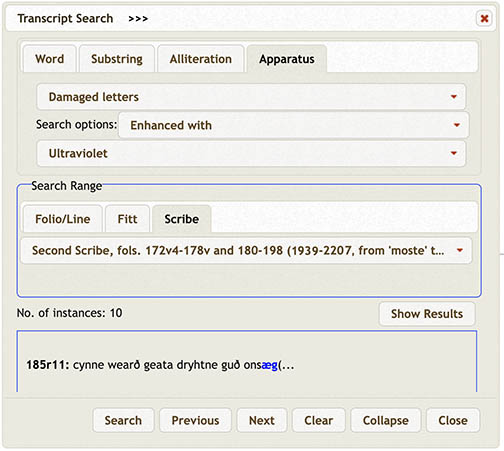
To see its textual note use GoTo to open the folio and the red box to see all areas containing textual notes.
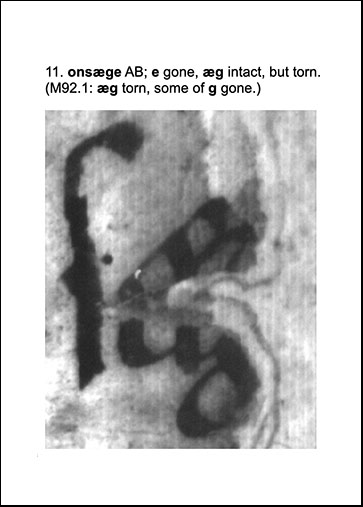
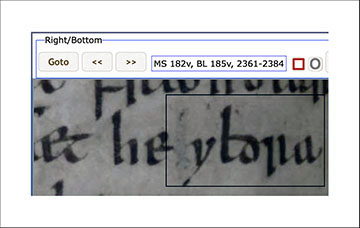
At 185r11 æg in onsæge is torn, but not otherwise damaged. (Click in the menu bar above the folio page to see linked textual notes, here with a UV illustration.)
Deletions and Erasures
Scribal deletions and erasures are recorded by MS folio and line number; the Search Options are Comprehensive, How, Who, and Enhanced with; the Search Ranges are by Folio/line, Fitt or Scribe.
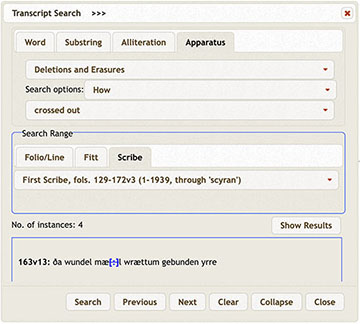
In this example, the Search Option How (with choices of 'crossed out,' 'underdotted,' 'erased,' or 'miscellaneous') shows that the first scribe crossed out g (and replaced it with l) in mæl on 163v13.
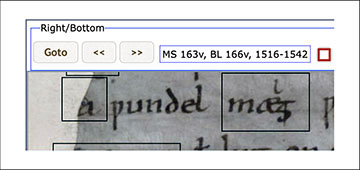
Every listed instance may be viewed on its folio and is linked to its textual note, often with an enlarged illustration.
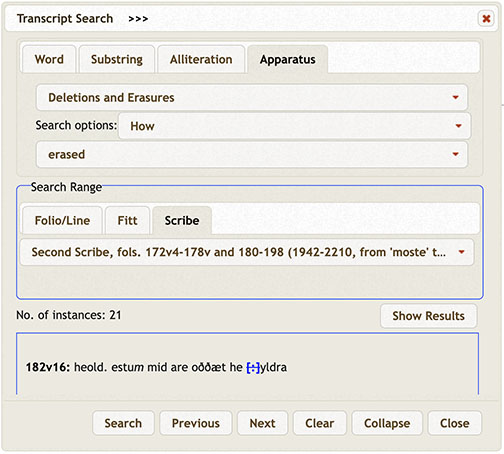
As with Deleted readings, Erased ones are represented by bracketed colons, the number corresponding to the number of deleted or erased letters. The erased text (when still legible) is the 'value' of the erasure.
Enhancements
Erased, faded, and otherwise defective or illegible readings are often enhanced under ultraviolet. In this case, the search was limited to results between folios 147r and 154v, and shows the result for 153r16.
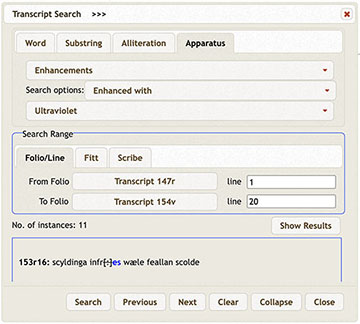
To examine the details of 153r16, GoTo Transcript (or Edition), click and then the rectangle at line 16 to see its textual note.
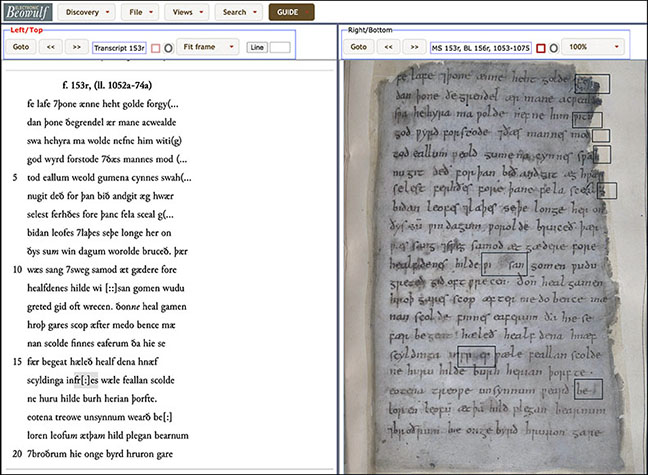
In the textual note to folio 153r16, ultraviolet reveals that the scribe corrected a mistake in the course of making it. The scribe started incorrectly to write fes w, but then, before proceeding further, erased the mistake and corrected it to fr—es wæle.

Restorations
Restorations are not searched under Transcript, but under Edition. In the Edition Search they are found under Apparatus > Emendations (including illustrated Conjectural Restorations on the palimpsest and the following folio), and both Early Restorations (by Wanley, Thorkelin A [James Matthews], Thorkelin B, and Thorkelin A and B together) and Editorial Restorations.
Treated with Reagent
In modern times someone attempted to restore faded, erased, or otherwise illegible text by applying chemical reagents, which show as swabbed areas under ultraviolet. The Search results report that all cases are confined to fols. 179rv and 180v1-3. This example is from the bottom half of fol. 179r.
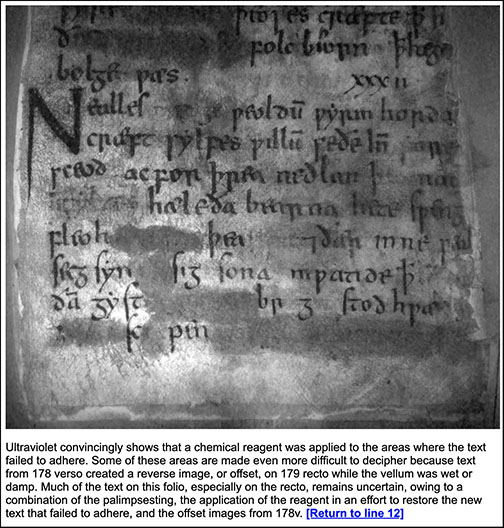
The Thorkelin readings imply that the reagent may have improved the legibility of 180v1-3 today, but the stains brought out by UV on 179rv further obscure the original text.
Uncertain
This search retrieves uncertain readings, the majority of which come from the heavily damaged folios 179 and 198. Search results include in some cases 'alternative readings.' All uncertain readings appear in the search results and in the Transcript in brackets.
Written over Erasure
Nearly all examples are from folio 179, a palimpsest. The original text was thoroughly removed and for the most part remains totally unreadable. The current text, somewhat shorter than the one it replaced, was written in a slightly different, later hand, showing influences of the caroline letters favored by the first scribe.
For the identification of a third Beowulf scribe and a detailed analysis of the palimpsest of fol. 179, recto and verso, see Kiernan, "The nathwylc Scribe and the nathwylc Text of Beowulf."